“When we make Play the foundation of learning, we teach the Whole Child” (Vince Gowmon)

Experiences over the past 20 years of my teaching career have led me to the philosophy that play, playful learning, and play-based learning are essential parts of Early Childhood Education (ECED). Research describing the purposes and benefits of play echo my observations. Play comes in many forms, expressions, and languages. It is unique to the individual, the context, the community, and the culture it is created in. Children are active participants and meaning makers; who create, connect, and reconstruct meaning through play. We can learn so much about play, learning, and life from children; and so much about children from play.
Reviewing literature on the purposes and benefits of play, validated my beliefs that play can support many aspects of learning, growth, development, and well-being of children. Research indicates that play positively influences children’s social cognition, emotional development, self-regulation, and academic learning (Pyle, DeLuca & Danniels, 2017). It is valuable for teachers, families, students, and other community members to understand play and how to support it.
Exploring different kinds of play and play-based learning provides guidance about integrating play at home, school, and in the community. Pyle and Danniels (2017) identified five types of play, situated along a play-based continuum:
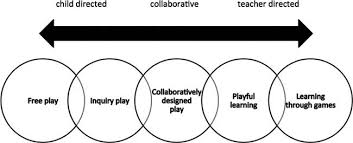
The conceptualization of this play continuum inspires me to include a range of play experiences in my classroom. I work to make time each week for different types of play from child-directed free play to adult-guided play. Child-centered, interest-based, free choice endeavours focus activities that allow for voice and choice, including building roads for cars, building blocks, kitchen centre, dress-up centre, and creation station. I use concepts of collaborative play to guide me in extending child initiated play by bringing in learning aspects. For example, providing support for students to write a menu sign for their restaurant, record customer orders, or use money for transactions. I also make time for playful learning invitations, including sensory experiences; exploratory activities; science, numeracy, or literacy learning stations (natural materials, loose parts, play dough, magnetic letters/numbers on cooking sheets, letters/numbers hidden in a sensory bin, etc.). In addition, I make time for playful learning (songs, dance and movement, games, puzzles, etc.); and learning through games (BINGO, matching games, rhyming games, card or dice games, etc.). This range of play, ensures that I am working with children to create play and learning experiences that are authentic, engaging, and motivating.
“Play touches and stimilates vitality, awakening the whole person – mind and body, intelligence and creativity, sponteneity and intuition” (Viola Spolin)
Here are some examples of play-based experiences from my Kindergarten class:
There can be challenges to integrating play into the classroom, including pressures from academic standards; unclear messages from policies; lack of support from administration or colleagues; issues related to classroom management; lack of time and resources; lack of access to research, knowledge, and strategies to inform practices; or overwhelming information about play pedagogy. However, exploring research and resources related to this topic has expanded my teacher toolkit, improving my ability to work with students, families, and other community members to build a meaningful Kindergarten program together.


References
Gowmon, V. (2014). Retrieved on March 1, 2021 from https://www.vincegowmon.com/the-therapeutic-
power-of-play-to-heal-shame-in-children/
Pyle, A., & Alaca, B. (2018). Kindergarten children’s perspectives on play and
learning. Early Child Development and Care, 188(8), 1063-1075.
Pyle, A., & Bigelow, A. (2015). Play in kindergarten: An interview and observational
study in three Canadian classrooms. Early Childhood Education Journal, 43(5),
385-393.
Pyle, A., & Danniels, E. (2017). A continuum of play-based learning: The role of the
teacher in play-based pedagogy and the fear of hijacking play. Early Education
and Development, 28(3), 274-289.
Pyle, A., DeLuca, C., & Danniels, E. (2017). A scoping review of research on play‐
based pedagogies in education. Review of Education, 5(3), 311-351.
Spolin, V. (n.d). Retrieved March 1, 2021 from https://www.azquotes.com/
quote/914660