
“In diversity there is beauty and there is strength” (Maya Angelou)
To share how play can be used to honour the diversities and complexities of children’s unique contexts and needs.
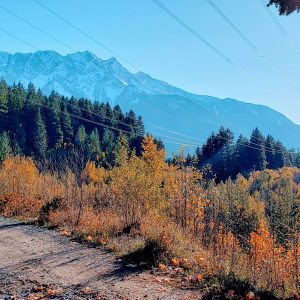
While reflecting on my second goal, I discovered several quotes about the significance of diversity for beauty, strength, and necessity. This inspired me to make connections between the importance of biodiversity within the forest ecosystems and the diversity within education and leadership. As I explored concepts regarding the strength of biodiversity in ecosystems, I learned that more diversity allows a forest to be healthy and resilient because it is stronger, functions better, and adapts well to changes. In nature, systems that are losing diversity may decline slowly at first; however, when too much is lost the ability to thrive and survive is threatened. Biodiversity measures variation at all levels; therefore, when looking at it the whole picture, diversity is essential to the individual child and to the collective; just as biodiversity is vital to the tree and the forest ecosystem.
“Diversity is not a characteristic of life; it is a condition necessary for life…like air and water” (Barry Lopez)
The concept of biodiversity demonstrates how we can simultaneously support both individual and collective needs by celebrating diversity in early learning settings (Woodhead, 2006) and leadership spaces (Giugni, 2011). Play is a relevant and meaningful way to integrate the dynamic and multifaceted dimensions of children’s contexts, including funds of knowledge, social, cultural, and linguistic aspects (Chesworth, 2016). In early childhood education, there may be urges to simplify these complexities out of convenience to achieve clarity in common philosophies, practices, policies, and future directions (Wood, 2014; 2016). It may feel uncomfortable at times, but this means acknowledging and allowing the tensions, disruptions, and conflicts that exist; and learning from them – rather than ignoring them (Wood, 2016). It is our uniqueness as individuals and our inclusion of diversity as a collective that allow us to learn, grow, change and transform (Giugni, 2011; Moss, 2017; Nicholson et al., 2020).
Artifacts for Goal 2: Honour
Thriving ~ Rising Up



References
Angelou, M. (n.d). Retrieved March 1, 2021, from: https://www.goodreads.com/
quotes/9776070-in-diversity-there-is-beauty-and-there-is-strength
Chesworth, L. (2016). A funds of knowledge approach to examining play interests:
listening to children’s and parents perspectives. International Journal of Early
Years Education, 24(3), 294-308.
Giugni, M. (2011). ‘Becoming worldly with: ’An encounter with the Early Years
Learning Framework. Contemporary Issues in Early Childhood, 12(1), 11-27.
Lopez, B (n.d). Retrieved on March 1, 2021, from: http://www.quotehd.com/quotes/
barry-lopez-quote-diversity-is-not-a-characteristic-of-life-it-is-a-condition-
necessary-for
Moss, P. (2017). Power and resistance in early childhood education: From dominant
discourse to democratic experimentalism. Journal of Pedagogy, 8(1), 11 – 32.
Nicholson, J., Kuhl, K., Maniates, H., Lin, B. & Bonetti , S. (2020). A review of the liter
ature on leadership in early childhood: examining epistemological foundations
and considerations of social justice, Early Child Development and Care, 190:2,
91-122.
Wood, E. (2016). Understanding complexity in play through interpretivist research.
The SAGE Handbook of early childhood research. SAGE Publications, Ltd.
Wood., E. (2014). Free choice and free play in early childhood education: troubling the
discourse. International Journal of Early Years Education, 22(1), 4-18.
Wood, E. (2014). The play-pedagogy interface in contemporary debates. In L.
Brooker, M. Blaise, & S. Edwards (Eds.), The SAGE handbook of play and learn
ing in early childhood, (pp. 145-156). Thousand Oaks, CA: Sage.
Woodhead, M. (2006). Changing perspectives on early childhood: theory, research
and policy. International Journal of Equity and Innovation in Early Childhood 4
(2), 1-43.