“Look deep into nature, and then you will understand everything better” (Albert Einstein)

The inspiration for my “Meta-forest” comes from my love of nature, including the forests, the mountains, and the place I call home.
This Master of Education Program provided me with rich conditions, giving rise to remarkable challenge, growth, and expansion. To reflect on my personal and professional development over the past 2.5 years, I will be using a metaphor, which I call a “meta-forest,” to represent my learning and growth. I will also be using the meta-forest, to present the approaches I take when considering learning, development, and growth of the students in my Kindergarten class. In this representation of the meta-forest, we are all trees with potential for growth, given hospitable living conditions (sun, soil, space, water) needed to survive; just as rich learning conditions (support, engagement, connection, challenge) are needed for learners to thrive.
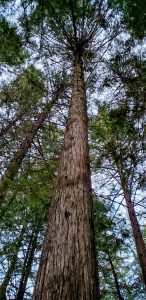
This play on words, a “simil-tree” – if you like, imagines children as trees in the forest, with potential for growth. Each child, like a tree, lives and grows among other trees (people such as parents, family members, teachers, friends, other community members) in the forest. The forest is the child’s support system, including social networks of the school, community, and greater society. The trees, conditions, and other elements of the forest ecosystem are interconnected like the circumstances of the child’s systems in Bronfenbrenner’s Ecological Systems Theory (1994). The tree interacts with many parts of the ecosystem, including other trees, plants, living creatures, and even other forest systems. Each tree responds to the conditions in their forest, including seasons, climate, weather, wind, sun, soil, water, and space. This occurs, just as the child interacts with dimensions of the systems present in their life, including contexts; personal, social-cultural, language and circumstances of those structures; relationships, support, experiences. Place-based perspectives and Indigenous Ways of Knowing honour connections to the land, to all creatures, relationships, time and place (Cohen & Ronning, 2017; Gruenewald; 2003a; 2003b; Sobel, 2004; Wood, 2016; ).
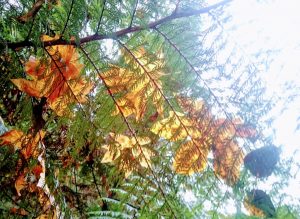
In this analogy of trees in the forest, I will explore how play can act as an important condition to help children and other members of the educational community, and greater society; grow and flourish. Just as, conditions of sun, space, and soil; or even moderate stresses of weather and wind; can help each individual tree, the entire forest, and greater ecosystems survive and thrive.
Each page of this e-portfolio, will be rooted in this meta-forest, where all of us are trees full of potential to learn, grow, and connect. When we develop a solid foundation by growing strong roots, we are able to thrive; rising up and reaching out – extending branches and connecting to others.


References
Bronfenbrenner, U. (1994). Ecological models of human development. In International
Encyclopedia of Education, 3(2). Oxford: Elsevier.
Cohen, B. J. & Rønning, W. (2017). Place-based learning: Making use of nature in
young children’s learning in rural areas in Norway and Scotland. Cad. Cedes,
Campinas, 37(103), 393-418.
Einstein, A. (n.d.). Retrieved from: https://www.goodreads.com/quotes/32930-look-
deep-into-nature-and-then-you-will-understand-everything
Gruenewald, D.A. (2003a). The best of both worlds: A critical pedagogy of place. Edu
cational Researcher 32(4), 3-12.
Gruenewald, D.A. (2003b). Foundations of place: A multidisciplinary framework for
place-conscious education. American Educational Research Journal, 40(3), 619-
654.
Sobel, D. (2004). Place-based education: Connecting classrooms & communities.
Barrington, MA: The Orion Society.
Wood, E. (2016). Understanding complexity in play through interpretivist research.
The SAGE Handbook of early childhood research. SAGE Publications, Ltd.