Carla Montie
UBC Faculty of Education
LLED 556A-62A
Instructor: Guofang Li
Introduction
“Play is the Universal Language of Childhood” (author unknown)
For as long as I can remember, I have always loved exploring and learning through play. Throughout my childhood, my family spent a great deal of time interacting, connecting, and communicating together through play. I am thankful for the consistent opportunities I had as a child to engage in ways that were authentic, meaningful, and powerful to me. Over the years, the importance of play has continued in both the personal and professional spheres of my life.
When I first went to school, I remember feeling like a foreigner in a strange place. I often felt uncomfortable, unmotivated, and overwhelmed when experiencing traditional forms of literacy learning. When I was not able to perform literacy expectations, I felt like I was not a ‘good student.’ Looking back all those years ago, schools predominantly consisted of back-to-basics approaches, providing direct instruction of academic fundamentals. At that time, children were often seen as passive receivers of knowledge, rather than capable participants in their own learning and in their own lives. As a child, I was an active learner, who needed to explore through hands-on, interactive experiences. Literacy is a significant aspect of being a confident learner in the classroom. Consequently, for many years I felt like a ‘bad student’ and a failure at school. Throughout my teaching career, students continue to reveal unique strengths and diverse needs – and I do not want any child to feel the way that I did. Now as a teacher, I ask myself, what kind of literacy learning experiences do I want to share with my students?
Over the years, there have been surges towards increasing academic standards in Kindergarten, which puts pressure on educators to push children to reach literacy and other academic curricular milestones. This drive has caused divisions and tensions between academic learning and developmentally (and contextually) appropriate practices, such as play. While examining early childhood language and literacy education this term, I realized that I would like to continue to explore literacy and play. Many educators, parents, and researchers agree that play is vital for children. There is also consensus regarding the significance of literacy development in the early years, for later successes in learning and in life. Can we use play to support children’s early literacy growth?
This paper will explore play and literacy, in a Kindergarten classroom context. For the purpose of this paper, I will use the term play-literacy learning to refer to play-based approaches to literacy development. Furthermore, I will use the term literacy in a broad sense, inclusive of diverse forms of literacies, languages, and communication. Some guiding questions include: What is play and play-based learning? How can play be used to ignite literacy learning? How can play-literacy learning be used to support the diverse contexts of all children? What is the role of the environment in play-literacy learning? What is the role of the educator in play-literacy learning? What does a child-centered, play-based, literacy-rich Kindergarten program look like? The organization of this paper will consist of (Part 1): Literature Review; (Part 2): Professional Implications; and (Part 3): Conclusion.
Review of the Research Literature
In a literature review, I will explore play-literacy learning, in a Kindergarten context. I have organized the review into the following five themes: (1) definitions of play and play-based learning; (2) the role of play in literacy learning; (3) the role of the child in play-literacy learning; (4) the role of the environment in play-literacy learning; and (5) the role of the educator in play-literacy learning.
Definitions of Play and Play-based learning
Definitions of play and play-based learning have been a popular topic of discussion and debate for years. Play approaches view play as an essential part of childhood learning and life. Notions of play often include aspects of personal choice, intrinsic motivation, elements of control or power, opportunities to be nonliteral, components of uncertainty or risk, and overall feelings of enjoyment (Mraz, Porcelli & Tyler, 2016). Forms of play are open and unlimited, including many types of play such as imaginative play, socio-dramatic play, creative play, constructive play, exploratory play, rough and tumble play, and risky play. Play-based learning approaches view play and learning as connected and complementary, providing children with opportunities to learn while at play. Collecting information regarding meanings and actions of play and play-based learning contributes to research and guides practices and policies. Continuing to understand play and play-based learning is important in developing effective and appropriate experiences for children. This reflective process can continue to evolve perspectives of play, enrich practices, and enhance programs to support children’s literacy learning.
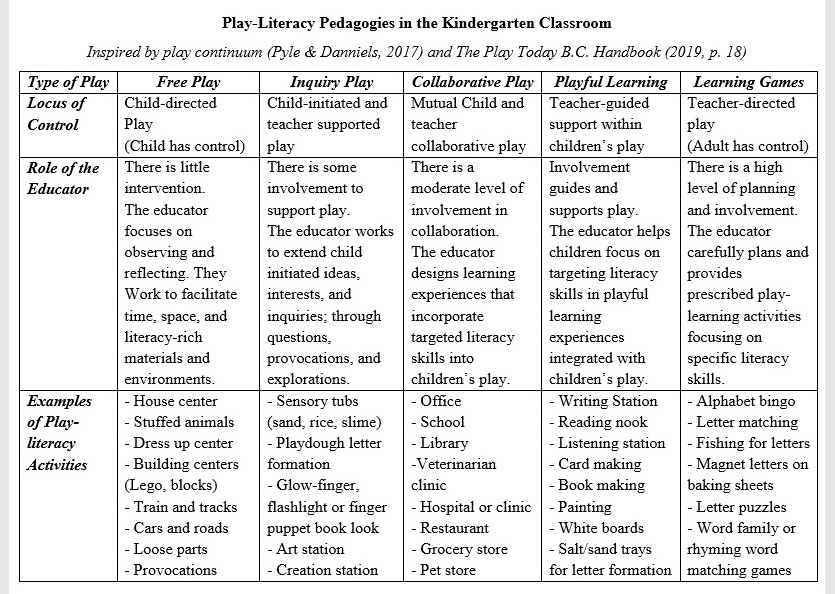
Pyle and Danniels (2017) offered some working definitions of play and play-based learning. This study explored play-based learning, in 15 public Kindergarten classrooms, in Ontario, Canada. The results of this study identified five different types of play, situated along a continuum, ranging from child-directed, to collaborative, to teacher-directed play. The types of play included free play, inquiry play, collaboratively designed play, playful learning, and learning through games. The conception of this play continuum shows that open, inclusive, and holistic approaches work to use a diverse range of play-based experiences to support children’s learning, growth, and development.
Pyle, DeLuca and Danniels (2017) offered further insights into definitions of play and play-based learning when they provided a comprehensive review of research on play pedagogies. This review analyzed 168 articles that addressed play-based learning for children aged four and five. The authors explained that two distinct types of play are typically explored in research and literature: child-directed free play and teacher-directed play-based learning. They also stated that some research referenced a third type of play that is collaborative, mutually-directed, by both students and educators. Free-play gives children opportunities to freely choose and engage in a variety of play activities without guidance from adults. Collaborative play allows educators to be involved during student’s play to capitalize on potential learning opportunities. Teacher-directed play engages students in intentionally planned, purposeful play-based learning opportunities, with adult support. Pyle et al. (2017) pointed out that these types of play are defined by who has the locus of control during the activity, rather than the nature of the activity. As a result, all three types of play can involve a diverse range of activities and resources, manipulatives, materials, and props. According to this review, research indicates that these types of play are beneficial strategies of providing children with rich learning opportunities.
The Role of Play in Literacy Learning
The role of play in supporting children’s growth has also been a popular topic of discussion and debate. Extant research provides evidence that play-based early childhood programs can support children in both development and learning. How does this data relate to language and literacy? In relation to development, Mraz et al. (2016) explained that extant research shows that play is beneficial for children’s growth within the five developmental realms: physical, cognitive, language, social, and emotional. When looking specifically at language acquisition, this book reported research that indicates that play supports children’s overall language development, as it can advance verbal skills, increase vocabulary, and improve language comprehension. With respect to emergent literacy, the authors stated that some research suggests that many skills children develop through play transfer to pre-literacy skills, including symbolic forms that are relevant in reading and writing.
In the review by Pyle et al. (2017), their analysis revealed that there are two distinct perspectives concerning the role of play: play for developmental learning and play for academic learning. The authors pointed out, that this division indicates that there are different perceptions about the values and benefits of play. They also explained that this binary view of play calls for a need to move away from simple, static, and closed notions of play – towards more complex, dynamic, and open ones. The divisive themes that emerged from this overview suggest several important implications and recommendations for play-pedagogies. Primarily, there is no need to dichotomize notions of play, as it can support both developmental learning (i.e. cognitive, language) and academic learning (i.e. literacy). In addition, play-literacy should be viewed as broad, dynamic, and complex so that practices are inclusive, diverse, and holistic. Furthermore, integration of diverse types of play experiences are compatible and complementary rather than contesting and opposing. This review revealed that more research is required to explore best practices of play-literacy, in the Kindergarten classroom.
Pyle and Bigelow (2015) examined three teachers’ approaches to integrating play-based learning in their Kindergarten classrooms, in three schools, in Ontario, Canada. Data collected from each classroom was analyzed to create three unique representations. The results showed three distinct themes: (1) “play as peripheral to learning”; (2) “play as vehicle for social and emotional development”; and (3) “play as vehicle for academic learning” (Pyle & Bigelow, 2015, p. 3). The findings of this study revealed a relationship between play-learning beliefs and practices. Educator beliefs about the roles (purposes) of play are directly related to implementation of play (practices) in the classroom. The themes that emerged in the study modeled specific strategies of integrating play-based learning; including providing play-literacy opportunities during free-time, using play-literacy experiences to help develop language skills, and facilitating play-based practices to focus on academic literacy learning. The study pointed out that a variety of strategies can be used in order to create a dynamic Kindergarten Program. In terms of future directions, the authors called for a need for further research to determine how to use these play-based approaches to support developmental and academic learning.
Pyle, Prioletta, and Poliszczuk (2018) explored the integration of play-based pedagogies and literacy learning, in 12 Kindergarten classrooms, in Ontario. Two different groups of teachers emerged from the data analysis. One group was the ‘play and development group’ who dichotomized play and learning. The other group was the ‘integrated play and learning group’ who combined play and learning. Educators in the play-learning combined environments believed that play was important for children’s literacy learning. As a result, they incorporated a diverse range of strategies to facilitate play-literacy learning. Furthermore, these educators took active roles by collaborating and supporting children’s literacy engagement during play. In these Kindergarten classrooms, there was evidence of students participating in play-literacy experiences, demonstrating that play and literacy can be integrated effectively. The authors provided some recommendations for educators, which included: (1) using a diverse range of strategies and activities for play-literacy integration; (2) encouraging students to integrate literacy and play; (3) facilitating literacy-rich environments with resources and materials; and (4) taking an active role by participating with students to support literacy during play.
An article by Roskos and Christie (2011) called for a need to focus on the potential of play-literacy pedagogies, as they explored the question: “Does play make a difference in early literacy development” (abstract). The authors explained there is significant evidence that there is a critical cognitive connection between play, language and literacy: “[a]t the crux of the play-literacy connection is language” (p. 89). The focus of this article was sociodramatic play, which is the most mature form of play, and the type of play that is most closely related to emergent literacy behaviours. Roskos and Christie explained that sociodramatic play can be a powerful way to support literacy, as it consists of symbolic representation, social interaction, role-play, imaginative use of language, and sustained play activity. In addition, language use in sociodramatic play contributes directly to cognitive skills needed for literacy. The authors stated that it is vital to develop research designs to study the complexities of children in play contexts so that play-literacy can be pushed into new and dynamic directions.
The Role of the Child in Play-literacy Learning
It is widely accepted that Kindergarten program planning should be linked to students, their families, and their lives to inspire authentic and meaningful play and learning opportunities. Sociocultural approaches call for an integration of children’s identities, contexts, and funds of knowledge into play and learning. Play-based pedagogies can be used to recognize and respond to each child’s unique experiences as they make sense of language, literacy, and the world around them. Play can motivate children to interact critically with literacies as they make, challenge, and reconstruct meaning. In addition, play-literacy learning can invite children to make connections between home, school, community, and other spheres of participation. More research is required to explore how to use play-literacy experiences to access children’s funds of knowledge and empower them to be active participants in their own learning.
Children’s ideas, interests, and inquiries can be incorporated into play-literacy experiences to inspire authentic learning. Hedges, Cullen, and Jordan (2011) defined the term children’s interests as “…children’s spontaneous, self-motivated play, discussions, inquiry, and/or investigations that derive from their social and cultural experiences” (p. 187). This study explored the nature of children’s interests in relation to children’s experiences and funds of knowledge. It also examined how teachers work to construct curriculum by realizing and engaging with children’s interests and inquiries. This study took place in two early-childhood settings, in New Zealand. Findings from this study indicated that children’s interests and inquiries are inspired by their funds of knowledge, which are formed during participation in everyday life experiences. As a result, educators need to move beyond basic notions of the “…well-resourced, child-centered, play-based environment to interpret and respond to children’s interests” (Hedges et al., 2011, p. 186). The authors recommended that educators engage more actively and authentically with children, families, and communities in order to gain deeper understandings of their contexts. More research is needed to explore how interest-based approaches can honour children’s ideas, interests, and inquiries and connect them to play-literacy in the classroom.
The Role of the Environment in Play-literacy Learning
Research tells us that play-based classroom environments can provide a supportive atmosphere for children’s overall growth, health, and wellbeing. Furthermore, research indicates that play-based environments can provide rich learning contexts for literacy development. Environments that utilize play-literacy pedagogies offer children opportunities to connect, interact, and learn with others and with the world around them. Play-literacy environments invite the freedom and flexibility for children to engage with meaning in powerful ways. Play-literacy settings set the stage for open and accessible learning experiences, as children can explore using universal languages and practices of play, despite personal, social, and cultural factors. Given the potential of play, I wonder: Can play-based learning environments enhance Kindergarten literacy programs? If so, how can the classroom environment be used as a ‘third teacher’ to facilitate play-literacy learning?
Stegelin (2005) reviewed a variety of research-based reasons to support play-based learning environments, and found that it is important to set up rich play-based settings in the classroom to allow children to engage in rich literacy events. Stegelin (2005) offered four strategies to help create a healthy play-literacy learning environment including; use of literacy props, integration of art activities, emphasis on environmental print, and incorporation of playful literacy activities. Stegelin called for the use of literacy props, which are developmentally appropriate resources, artefacts, materials, and writing tools. Literacy props include puppets, stuffed animals, dramatic-play items, books, markers, signs, and paper; and can be placed in play-learning centers to increase the quantity and quality of literacy experiences in the classroom environment. Stegelin also called for integrating art activities into the classroom environment to promote literacy learning, including drawing, painting, pretend printing, and letter stamps. In art contexts, children are provided with opportunities to represent letters, invent words, and create imaginary worlds through artistic forms. In addition, Stegelin recommended setting up print-rich environments to facilitate play-literacy experiences that encourage alphabet awareness, expand vocabulary, and promote understanding that print has meaning. Educators can provide environmental print in the classroom, including maps, menus, signs, posters, newspapers, magazines, and many types of books. Furthermore, Stegelin stated that incorporating diverse literacies helps expose children to a range of literacy features, genres, purposes. Some examples include poetry, songs, chants, rituals, repetitive activities, oral storytelling, role-play, drama, and making kinesthetic connections. An important point made in this paper is that children are coming from positions in society that may advantage or disadvantage them. Therefore, it is essential to offer play-based experiences within the classroom environment to give all students access to literacy building skills.
The Role of the Educator in Play-literacy Learning
Educators have the challenge of supporting diverse groups of children, in their classrooms. Play can be a powerful way for educators to provide children with opportunities to build literacy skills in a relevant, meaningful, and motivating context. A play-based learning environment is an essential component of a high-quality Kindergarten literacy program. However, is a literacy-rich setting enough to ensure learning occurs through play, or is adult support needed? If adult support is required for play-literacy learning to occur, what is the role of the educator? Does this role vary, based on the activity?
A study by Pyle et al. (2018), found that adult involvement is required to ensure children engage in play-literacy learning. The study examined 12 Kindergarten classrooms, in Ontario; and discovered two separate perspectives of the educator’s role in play. One perspective was that play is beneficial for oral language development but not for learning literacy skills; therefore, the educator should have a passive role in play. Another perspective, was that play is an important way to support literacy learning; therefore, educator involvement is necessary during play. Pyle et al. (2018) recommended integrating diverse types of play into the classroom, ranging from child-directed to teacher-directed contexts, in order to target literacy skills. More research is needed to explore the different roles educators can take to best support students engaging in diverse play-literacy activities.
In another study by Pyle and Alaca (2018), research was conducted from Kindergarten children’s perspectives on the connectedness of play and learning. Ten Kindergarten classes were selected, in Ontario, Canada. Results indicated that children’s understandings of connections between play and learning were related to teacher presence in play. “In classrooms where opportunities to engage in varied types of play were provided, the students expressed the perspective that play and learning were connected” (Pyle & Alaca, 2018, p. 1071). The study recommended that educators take on an active role in play-based learning experiences to encourage children to see play as a learning opportunity. This study suggested that educators should talk to children about the connections of play and learning so that they are aware of and open to learning through play. Educators can promote play-literacy connections by explicitly communicating the values, purposes, and roles of play in literacy learning. This study makes a valuable contribution to research on the topic, as it includes children’s perspectives. However, more research is needed to understand children’s views and experiences of play-literacy learning.
Although, some studies have shown that play-based approaches to learning can lead to positive literacy outcomes. One study yielded stark results regarding children’s success accessing play-literacy learning opportunities. Neaum (2018) explored young children’s engagement with literacy provisions during child-directed play. Research for this study took place in a nursery, consisting of low socio-economic demographics, within a primary school, in the northeast of England. This study showed that despite providing children with play-based literacy-rich environments during free play, their language and literacy interactions were limited. While, these findings are discouraging, perhaps they warrant further investigation into the role of educator involvement to stimulate and support children’s literacy learning through play. For example, in this study, the educators offered literacy resources for the children to use in play; however, they did not take active roles in the play. In addition, it is important to consider other possible factors affecting these results, including the young age and developmental stage of the children, the socio-economic status of the children, a possible lack of exposure to previous play-literacy experiences, or a possible absence of awareness of play-literacy connections.
Professional Implications
Benefits of Play-literacy learning
High quality Kindergarten programs can teach children to think critically and creatively so they can succeed in an increasingly complex and constantly changing world. Play-based learning can be viewed as an open and unlimited process, as it inspires children to gain knowledge and continue to build on a path of life-long learning. Play-based pedagogies can offer children opportunities to explore notions of playing to learn and learning to play. Such as, playing to learn about literacies and learning to play with literacies. Play-learning experiences encourage children to be active participants in their own learning, as they interact with others; create and innovate meaning; challenge and re-imagine the world around them. Educators can support children by providing them with rich and diverse play-literacy experiences, which are naturally engaging and motivating. When establishing play-literacy pedagogies, it is important for the educator to take on a holistic, inclusive, and balanced approach by considering unique contexts of children and their families. This process includes reflecting on a range of factors such as strengths and needs; interests and inquiries, languages and literacies; and other social and cultural aspects.
Local Frameworks and Supporting Documents
As research continues to make contributions, perspectives of play continue to evolve and so do early learning practices, policies, and supporting documents. There are several frameworks in British Columbia that support and guide play pedagogies in early learning environments, including the B.C. Early Learning Framework (2019) and The Play Today B.C. Handbook (2019). The B.C. Early Learning Framework (2019) states that play is essential to children’s growth, well-being, and learning. This framework calls for educators to broaden meanings associated with play to enrich perspectives and enhance practices, in order to create high quality learning programs. “Play can be individual, collective, spontaneous, planned, experimental, purposeful, unpredictable, or dynamic….Play is an approach to inquiry, a way to research the world. By providing diverse materials and experiences, educators create spaces for experimentation and transformation” (p. 24). This framework describes communication and literacies as living inquiries; which are ongoing, constantly evolving, multifaceted, non-linear, and dynamic. The framework offers pathways for engaging students with communication and literacies, including using multiple modes of communication; connecting culture, family, traditions, and knowledge; working to extend vocabulary, symbols, and written language; using sound and word play; and integrating technology (p. 66). Some examples include play dance, movement, construction, art, music, storytelling, and technology (p. 80). British Columbia educators are fortunate to have such a comprehensive map to direct their pedagogies.
The Play Today B.C. Handbook (2019) is a practical guide for offering high quality, play-based learning opportunities for children in the early years and beyond. This handbook shows educators how to effectively integrate play and learning experiences, routines, and behaviours into classroom environments. The document suggests that educators can work to negotiate a balance of play and learning by providing a diverse range of experiences along the play-learning continuum. The handbook explains that high quality programs provide important aspects of equal access, student participation, and support systems. In terms of providing equal access, this handbook recommends making language and literacy assessable to children by offering multiple forms of engagement and expression to ensure children with diverse needs succeed. Strategies to providing an inclusive program, include adapting the environment, incorporating technology, or modifying activities. In relation to participation, the handbook recommends a number of approaches, including teaching through routines, teaching through play, and varying amounts of direct instruction. With regard to supports, the handbook recommends that infrastructures are put in place to support children, families, and educators; including resources, policies, professional development, opportunities for collaboration. British Columbia educators are fortunate to have such a lively and joyful support document to inspire their practices.
Challenges of Play-literacy Learning
In the study by Pyle et al. (2018), educators expressed challenges related to implementing play-based approaches to literacy learning. Several challenges that educators identified were balance and workload. Educators indicated that they struggle with finding a balance between play-based approaches and ensuring children meet literacy curricula standards. Educators also expressed feeling overwhelmed by workload when trying to provide a diverse range of opportunities to students. Furthermore, educators described issues coping with high student-teacher ratio, as diverse student strengths and needs, demand many different learning outcomes. As a result, more research is required to determine how to negotiate a balanced Kindergarten literacy program that offers a range of rich play and learning opportunities in positive, productive, and manageable ways.
Conclusion
Today, educators are working with children, families, and communities; coming from diverse backgrounds and experiences of language and literacy, play and learning. As a result, educators must collaborate with children and families to create responsive and inclusive literacy programs that inspire play and learning for all. I look forward to future research discoveries regarding the integration of play and literacy to guide classroom practices, enhance early learning programs, and inform policies.
References:
Government of British Columbia. (2019). British Columbia Early Learning Framework. Retrieved
from: https://www2.gov.bc.ca/assets/gov/education/early-learning/teach/earlylearning/early_
learningframework.pdf
Government of British Columbia. (2019). The Play Today B.C. Handbook. Retrieved from:
https://www2.gov.bc.ca/assets/gov/education/early-learning/teach/earlylearning/play-today-
handbook.pdf
Hedges, H., Cullen, J., & Jordan, B. (2011). Early years curriculum: Funds of knowledge as a
conceptual framework for children’s interests. Journal of Curriculum Studies, 43(2), 185-205.
Mraz, K., Porcelli, A., & Tyler, C. (2016). Purposeful play. A teacher’s guide to igniting deep and
joyful learning across the day. Portsmouth, NH: Heinemann.
Neaum, S. (2018). Engaging with literacy provision in the early years: Language use and emergent
literacy in child-initiated play. Journal of Early Childhood Literacy.
Pyle, A., & Alaca, B. (2018). Kindergarten children’s perspectives on play and learning. Early Child
Development and Care, 188(8), 1063-1075.
Pyle, A., & Bigelow, A. (2015). Play in kindergarten: An interview and observational study in three
Canadian classrooms. Early Childhood Education Journal, 43(5), 385-393.
Pyle, A., & Danniels, E. (2017). A continuum of play-based learning: The role of the teacher in
play-based pedagogy and the fear of hijacking play. Early Education and Development,
28(3), 274-289.
Pyle, A., DeLuca, C., & Danniels, E. (2017). A scoping review of research on play‐based pedagogies
in education. Review of Education, 5(3), 311-351.
Pyle, A., Prioletta, J., Poliszczuk, D. (2018). The play-literacy interface in full-day kindergarten
classrooms. Early Childhood Education Journal, 46(1), 117-127.
Roskos, K. A., & Christie, J. F. (2011). Mindbrain and play-literacy connections. Journal of Early
Childhood Literacy, 11(1), 73-94.
Stegelin, D. A. (2005). Making the case for play policy: Research-based reasons to support play-based
environments. YC Young Children, 60(2), 76-85.
Bibliography
Banerjee, R., Banerjee, R., Alsalman, A., Alsalman, A., Alqafari, S., & Alqafari, S. (2016). Supporting
sociodramatic play in preschools to promote language and literacy skills of english language
learners. Early Childhood Education Journal, 44(4), 299-305.
Biordi, L., & Gardner, N. (2014). Play and write: An early literacy approach. Practically
Primary, 19(1), 6-9.
Chesworth, L. (2016). A funds of knowledge approach to examining play interests: listening to
children’s and parents perspectives. International Journal of Early Years Education, 24(3),
294-308.
Gregory, E., Long, S., & Volk, D. (2004). A sociocultural approach to learning. In E. Gregory, S.
Long, & D. Volk (Eds.), Many pathways to literacy: Young children learning with siblings,
grandparents, peers, and communities (pp. 6-20). New York: RoutledgeFalmer.
Hassett, D. D. (2008). Teacher flexibility and judgment: A multidynamic literacy theory. Journal of
Early Childhood Literacy, 8(3), 295-327.
Lester, S., & Russell, W. (2008). Play for a change: Play, policy, and practice: A review of
contemporary perspectives. London: Play England.
Lillemyr, O. F., Søbstad, F., Marder, K., & Flowerday, T. (2011). A multicultural perspective on play
and learning in primary school. International Journal of Early Childhood, 43(1), 43-65.
Wood, E. (2016). Understanding complexity in play through interpretivist research. The SAGE
Handbook of early childhood research. SAGE Publications, Ltd.
Wood., E. (2014). Free choice and free play in early childhood education: troubling the discourse.
International Journal of Early Years Education, 22(1), 4-18.
Wood, E. (2013). The play-pedagogy interface in contemporary debates. In L. Brooker, M. Blaise, &
S. Edwards (Eds.), The SAGE handbook of play and learning in early childhood (pp. 145–156).
Thousand Oaks, CA: Sage.
Wood, E. (2010). Developing integrated pedagogical approaches to play and learning. In P.
Broadhead, J. Howard, & E. Wood (Eds.), Play and learning in the early years (pp. 9–26).
Thousand Oaks, CA: Sage