Resources
Reviewing research-based evidence to inform pedagogy is a powerful process that can validate some existing practices and suggest changes to others. This process of review inspired reflection on a range aspects, including: working towards balance in my Kindergarten program, enhancing my understanding about the benefits and purposes of play, developing strategies used to incorporate play into my classroom, applying a range of roles to take on in play and learning activities, and navigating challenges of integrating play.
There is a lot of ground to cover in the first year of school, and as a result, there is a great deal of responsibility for educators to work towards holistic, inclusive, and dynamic programs. When looking into literature I discovered a push and pull between academics and play (Peterson, Forsyth & McIntyre, 2015). I also learned that there is no one size fits all model to program development. Each program should be a collaborative effort of adults and children to meet the unique needs of the class community. Some examples of ways I aspire to do this include; planning with students so that they can feel accountable and involved in the learning process, planning for students so that their interests and needs can be met, using student self-reflection and assessment as feedback, and re-evaluating and changing plans based on needs. This ongoing process strives towards establishing a joyful, engaging, and balanced curriculum by supporting optimal learning and development during the important early years of a child’s life
Observations and experiences over the past 20 years of my teaching career have led me to the philosophy that play, playful learning, and play-based learning are essential parts of Early Childhood Education. Reviewing literature on benefits of play, validated my beliefs that play can support many aspects of development, learning, and well-being of children. Specifically, I learned that play positively influences children’s social cognition, emotional development, self-regulation, and academic learning (Pyle & Danniels, 2017; Pyle, DeLuca & Danniels, 2017). Furthermore, two distinct perspectives of the benefits of play have emerged including; play for developmental learning and play for academic learning (Pyle, DeLuca & Danniels, 2017). These insights were extremely rewarding, as I have acquired a framework I can use to explain why it is important for children to engage in play in the classroom, which can be used to describe some benefits of play to colleagues, parents, and even students.
Reviewing some specific types of play and play-based learning provided guidance about integrating play into my classroom. Pyle and Danniels (2017) identified five different types of play, situated along a play-based continuum. This conceptualization allowed me to revise my plans to include a range of play experiences in my classroom, from child-directed ‘free play’ to adult-guided play. Now, I will be making time each week for different types of play, including child-centered free choice endeavours such as building roads for cars, building blocks, kitchen centre, dress-up centre, and creation station. Concepts of inquiry and collaborative play were used to guide me in extending child initiated play by bringing in some learning aspects. For example, providing support for students to write a menu sign in their restaurant, record customers’ orders, or use money for transactions. I have made time for playful learning activities such as; a magnet station, a weigh scale (measurement) station, a nature science station (natural objects to explore), and a variety of literacy stations (magnetic letters on cooking sheets, letters hidden in a sand bin, lacing letters, letter puzzles, etc.). I have also added time for learning through games, including a variety of exercises such as BINGO (letter, number, colour, etc.), matching games, rhyming games, card or dice games.
I have often been uncertain about what role I should take when children are engaging in play and play-based learning activities. Reviewing research by Pyle and Danniels (2017), and Pyle and Bigelow (2014) helped me learn some specific viewpoints regarding adult roles, determine my own perspectives, and discover what it can mean in my own classroom context. In free play activities, I decided that a passive role is important to avoid interrupting or disrupting play, unless help is needed to resolve a situation. In inquired or collaborative play, I determined that a shared role is appropriate to support students’ play and learning experience. In teacher directed or playful learning, guidance is required to ensure children have an opportunity to develop specific skills (literacy, numeracy, etc.). Learning about specific roles helped refine my teacher strategies for assuming a range of roles depending on the goal.
There can be challenges concerning integrating play into the classroom, including; pressures from academic standards, unclear messages from policies, lack of time and resources to provide students with opportunities to engage in purposeful play, lack of access to research, knowledge, and strategies to inform my philosophies and practices, or overwhelming information about play pedagogy. However, exploring research related to this topic has expanded my teacher toolkit, improving my ability to work with students, families, and other community members to build a meaningful Kindergarten program together.
References
The Pushes and Pulls of Play: Tensions within Play Pedagogy in ECED
Carla Montie
April 7, 2019
UBC Faculty of Education
EDUC 508B 62A
Instructor: Marlene Asselin
Introduction
Since the new millennium, Early Childhood Education (ECED) has been moving towards prioritizing academic standards for young learners, and promoting the use of play-based pedagogies. These two perspectives are often seen as binary, opposing, or contradictory rather than complimentary strategies to be used in a dynamic, multi-faceted approach to education. The perception that these views exist in a dichotomous, rather than a harmonious state has resulted in several tensions within perspectives, practices, and policies in ECED. Some areas of contention include: Tensions between academic learning and play-based learning; tensions between teacher-directed instruction and child-directed (student centered) exploration; and, tensions concerning overall understanding of play and play-based learning (in terms of definitions, benefits, purposes, roles of the adult, etc.).
In Canada, and many other countries, educational policies and curricula have been changing to acknowledge research promoting the importance of play as a way to support learning using developmentally appropriate pedagogy (Pyle & Danniels, 2017). There are several new mandates for play-based learning in early childhood education settings. In British Columbia, some examples include: The Play Today B.C. Handbook (2019), The B.C. Early Learning Framework (2019), The First Peoples Principles of Learning (2019), and the B.C. Curriculum and Core Competencies (2019). It is the professional responsibility of early childhood educators to review mandates and policies in order to inform their pedagogy. This process can help develop common culture, language, guidelines, expectations, and goals regarding the ways that play can be used in developmentally and academically appropriate learning contexts. Research about play is important, as it has the ability to further enhance and inform philosophy, practice, and policy in ECED. The ultimate goal is that all children can equally access age and context appropriate opportunities for health, happiness, well-being, and optimal development.
This paper will review some tensions within perspectives, practices, and policies of play and play-based learning in ECED. The organization of this paper will consist of: (1) Play-based learning versus Academic learning; (2) Definitions of play and play-based learning; (3) The benefits and purposes of play and play-based learning; (4) The role of the adult in play and play-based learning; (5) Limitations, obstacles, and implications of play and play-based learning.
Review of Literature
Play-based Learning vs Academic Learning in ECED
In the past few decades, we have seen an emphasis towards school readiness and academics in Early Childhood Education, transforming many settings into places where: Academics are being pushed and play is being squeezed out. A report conducted by the Alliance for Children, about 10 years ago, regarding the situation at the time; stated that:
“Two few Americans are aware of the radical changes in Kindergarten practice in the last ten to twenty years. Children now spend far more time being instructed and tested in literacy and math than they do learning through play and exploration, exercising their bodies, and using their imaginations. Many Kindergartens use highly prescriptive curricula which they may not deviate. Many children struggle to live up to academic standards that are developmentally inappropriate … At the same time that we have increased academic pressure in children’s lives through inappropriate standards, we have managed to undermine their primary tool for dealing with stress – freely chosen, child-directed, intrinsically motivated play” (2009, p. 15).
During this time, Nicolopoulou (2010) also wrote about the current alarming situation: “Across the board, play is being displaced by a single-minded focus on teaching academic skills through direct instruction. This emphasis on more didactic, academic, and content-based approaches to preschool education comes at the expense of more child-centered, play-oriented, and constructivists approaches, which are dismissed as obsolete or simply crowded out” (p. 1). Many academic-focused practices and policies may seem like practical, profitable, and beneficial initiatives, which are well-intentioned and have children’s best interests in mind. However unfortunately, they contradict much of what we know about young children’s learning and development and about the experiences that promote them. It is important to note that context appropriate direct instruction can be beneficial to young children if it is an aspect of a balanced approach and curriculum. “But a one-sided, or even exclusive, focus on top-down training in specific academic skills is developmentally inappropriate and counterproductive” (Nicolopoulou, 2010, p. 2). Such approaches are lacking many of the healthy, balanced, and appropriate practices we know are beneficial to helping children thrive in sensitive developmental early years. “Given what we know about the importance of play for young children’s intellectual, socioemotional, and physical development, suppressing it can have genuinely harmful effects” (Nicolopoulou, 2010, p. 2).
Years later, and other researchers have showed similar concerns about the push for academics at the expense of play. Significant research has demonstrated developmental and educational benefits of play; however, teacher-directed pedagogy still dominates many ECED classrooms and settings in Canada (Pyle & Danniels, 2017). A study by Peterson, Forsyth & McIntyre (2015), explored teachers’ perspectives on the following topics: Definitions of play, benefits of play, and challenges of play. This study included Kindergarten and Grade One teachers, from Alberta, Saskatchewan, Manitoba, and Ontario. Research findings (2015), revealed that participants believed that play is an important part of Kindergarten and Grade 1 experiences. However, Grade 1 teachers claimed that demands of student achievement of curriculum outcomes limits their use of play in classroom activity, as they feel pressured to teach mandated curriculum. “As such our research emphasizes the need for educators, curriculum developers, policy makers, and researchers to place high priority on working together to address these competing demands and to challenge tenets of the play ethos that present tensions in their work with young children” (Peterson et al., 2015, p. 46).
Tensions, discussions, and debates concerning play and learning have also been occurring in many countries all over the world. Several researchers have expressed a concern for the existence of competing or opposing ideals of play and learning, which construct simple, rigid, and binary views. Nicolopoulou (2010) discussed the danger of these viewpoints, creating opposition between play and learning, claiming that: “A rigid dichotomy between play and learning may seem commonsensical, but it is deeply misguided” (p. 2). As a result, some researches have called for a need for constructing more complex, open, and connected views and approaches that can help guide balanced and complimentary pedagogy.
Definitions of Play and Play-based Learning in ECED
In the past, research regarding play and play-based learning has provided unclear or narrow definitions, concepts, and approaches. However, a large body of current has demonstrated a much more open, clear, and concise representation of the topic. A study by Pyle and Danniels (2017) explored 15 public Kindergarten classrooms in three school districts in Ontario, Canada. This study (2017) has made significant contributions to the existing body of research on the topic because it helped construct and continue to refine more concrete and holistic definitions of play and play-based learning. According to Pyle & Danniels (2017), the term ‘free play’ is usually used to describe play that is child directed; child centered (locus of control is with the child), voluntary, spontaneous, flexible, and often involves pretend play or many other types of play (Weisberg et al., 2013). In contrast, ‘adult-guided play’ is usually described as the half-way point between direct instruction and free play, which can be child or adult initiated but the locus of control is with the child (Pyle & Danniels, 2017). Play-based learning has commonly been described as a teaching approach including child-directed and playful aspects, in addition to some degree of adult guidance or scaffolded learning objectives (Pyle & Danniels, 2017). Continuing to develop understanding, definitions and concepts are important because it can help establish a strong foundation of knowledge to continue to build upon. Providing clarity, not only enhances the existing body of research; but it also helps guide educational policies and practices. Hopefully this process can assist educators in developing a better understanding and some guidance on how to integrate play into their classrooms more effectively.
Questions surrounding the definitions, approaches, and activities that constitute play and play-based learning has been a popular topic of discussion and debate for years. Pyle & Daniels (2017) identified five different types of play, which are situated along what the authors call a play-based “continuum” (2017) ranging from child directed (free) play, to collaborative (guided) play, to teacher directed (instructed) play. The five different types of play included in this play-based learning continuum are: Free play, inquiry play, collaboratively designed play, playful learning, and learning through games (Pyle & Danniels, 2017). Free play is often the most common form of play observed in early childhood settings. Free play is on the most child directed side of the continuum, in which the locus of control is with the child (Pyle & Danniels, 2017). Next there is inquiry play, which is similar to free play, as it is child initiated, related to child’s interests, but the teacher extends the play through the integration of academic standards. Then there is collaborative play, which is child-directed play with educator support, identified as guided play. In collaborative play, the locus of control is shared, students make decisions about their play but are provided with guidance from the teacher in order to reach learning goals or objectives (Pyle & Danniels, 2017; Mraz, Porcelli & Tyler, 2016). Then there is playful learning, which integrates academic skills into play contexts that are collaboratively created, guided by the adult, and control is shared between the child and adult (Pyle & Danniels, 2017). And lastly, there is learning through games, which is the most prescriptive type of play based-learning on the continuum, on the side of adult directed. Math, literacy, or other academic standards and skills are promoted through fun and engaging games (Pyle & Danniels, 2017).
It should be noted, that there also seems to some discrepancy in the conceptualization (understanding and language) surrounding notions of play and play-based learning. The common occurrence of the two words being used vaguely or even interchangeably, may indicate that it is unclear what each word means and how each approach can be used. When Pyle & Danniels (2017) explored questions regarding the purpose of play and learning, a distinction emerged between the concepts of play and play-based learning. “The purpose of play-based learning is inherent in its name: to learn while at play. The purpose of play, in contrast, is far more open ended and frequently the topic of debate” (Pyle & Danniels, 2017). The purpose of play, the reason children play, and what activities constitute play are all issues that are often debated, however play is frequently described as joyful, engaging, and about the process not the outcome (Pyle & Danniels, 2017). In the case of play, typical notions of learning do not need to occur, therefore, play-based learning and play could be considered to be two distinct constructs.
The Benefits and Purposes of Play and Play-based learning in ECED
There is considerable literature on the importance of play and play-based learning in early childhood settings. Since the early 2000s, there has been a shift towards the use of play-based pedagogy in ECED. In education systems all over the world, the value and benefits of play-based learning approaches have been acknowledged, explored and endorsed in both research and educational contexts. However, despite some consensus regarding the value of play, a tension still exists debating the exact roles, benefits, and purposes of play. “Research has shown that play can facilitate student learning by allowing children to build on and extend their previous knowledge and skills through interacting with others and the environment” (Pyle & Danniels, 2017). A number of studies have shown that different types of play positively influence children’s social cognition, emotional development, and self-regulation (e.g. Lester & Russell, 2008; Pyle, DeLuca & Danniels, 2017; Pyle & Danniels, 2017) and academic learning (e.g. Weisberg et al., 2013; Pyle & Danniels, 2017), in some cases over direct instruction (Pyle & Danniels, 2017). Furthermore, recent advances in neuroscience show that play has a “significant role in the development of the brain’s structure and chemistry, which gives rise to emotional and physical health, well-being and resilience, as well as laying the foundation for cognitive functioning and social competence” (Lester & Russel, 2008, p. 45).
Despite the fact that many viewpoints concerning the benefits and purposes of play exist, Pyle, DeLuca & Danniels (2017) stated that overall, two distinct perspectives of the role of play have emerged: Play for developmental learning and play for academic learning. A report by Pyle et al. (2017) was a comprehensive review of research on play-based pedagogies in Kindergarten education. This review analyzed 168 articles that addressed play-based learning for children, aged 4-5. The authors (2017) stated that the majority of previous research endorsed play as being an important part of early learning. However, the fact that two distinct perspectives concerning the role of play for developmental or for academic learning, indicates that there are different perceptions about the value, role and benefits of play. Pyle et al. (2017) explained that this division within research suggests a need to move away from simple and binary views of pedagogy and towards more open and complex views. This recommendation called for an integration of a variety of perspectives and pedagogies of different types of learning through play, which are seen as complementary rather than incompatible.
Furthermore, Pyle & Bigelow (2015) conducted a study that investigated teachers’ perceptions about the purpose of play-based learning in three Canadian schools. The goal of the study was to explore three teachers’ approaches to integrating play-based learning in their Kindergarten classrooms, in public schools in a school district in Ontario. Data from each classroom was collected and analyzed to create three unique representations showing the relationship between purposes of play and implementation of practices of play within each setting. The results were displayed as individual class profiles, which revealed three distinct approaches to integration of play and learning in kindergarten classrooms: (1) “Play as peripheral to learning,” (2) “Play as a vehicle for social and emotional development,” and (3) “Play as a vehicle for academic learning” (Pyle & Bigelow, 2015, p.3). The authors explained that detailed data such as this can provide important insights regarding perspectives, purposes, and practices of play in early learning environments.
In addition to representation in literature, views concerning the benefits and purposes of play, are also being reflected in current policies and mandates, such as; The Play Today B.C. Handbook, The B.C. Early Learning Framework, the B.C. Curriculum and Core Competencies. For example, The Play Today B.C. Handbook states: “The experiences of children’s play have a profound impact on all areas of their growth and development” (2019, p.1). In addition, the B.C. Early Learning Framework states: “This framework values play as vital to children’s learning, growing, and making meaning” (2019, p. 27). However, despite the current state of research promoting the benefits of play and policy recommending play, friction still exists; including a great deal of discrepancy within early childhood educator’s perspectives and practices of play. Data from studies, such as Pyle & Bigelow (2015); and Pyle et al. (2017) are significant because they show specific ways teachers can integrate play and play-based learning (to foster developmental or academic goals) into the curriculum.
The Role of the Adult in Play and Play-based Learning
A number of diverse viewpoints have emerged regarding the role of the adult in play. In the study, Pyle & Danniels (2017), the authors examined the role of the teacher in play-based pedagogy and found that two different teacher profiles emerged: (1) A belief that play and learning are separate constructs and the role of the teacher is not central in play; and (2) A belief that play could support academic learning and that teachers can play an important role in play (Pyle & Danniels, 2017). The first perspective is that play is beneficial for social and emotional learning, so the role of the adult is to be passive and should “support but not disturb” or “hijack” the play (Pyle & Danniels, 2017). As a result, some educators philosophically oppose the notion of guided play because it is disruptive and interfering to learning that is naturally occurring. An alternate perspective is that play provides great opportunities for children to explore, learn, and internalize academic skills and concepts, so adult involvement is encouraged in order to support, guide, and extend children’s learning (Pyle & Bigelow, 2014; Pyle & Danniels, 2017). This perspective of the adult’s role as active is seen as being effective because learning experiences are powerful and can incorporate targeted skills into the joyful, engaging, and motivating realm of children’s play. With this approach, educators can use this method as an alternative to direct instruction by intentionally facilitating play-based learning experiences that integrate desired learning outcomes. While tensions exist, pulling these two views of the role of the adult in opposite directions, perhaps both of these approaches can be beneficial to play pedagogy.
Limitations, Obstacles, and Implications of Play in ECED
The definitions, roles, purposes, and benefits of play to children’s developmental and academic learning have been discussed and debated in a wide range of research. Differing perspectives and practices of play can make it challenging for educators to productively integrate play-based pedagogies into their classrooms (Pyle & Danniels, 2017). This point was also discussed by Youmans, Kirby & Freeman (2017), who explained that many educators report a lack of understanding of the purpose of play-based learning, how to implement it effectively, and what their role should be. Youmans et al. (2017) further explained that this is concerning because educators are often instructed to provide time for play without a clear understanding about how it can be used to support student developmental and academic learning. As a result, early childhood educators are not optimizing the benefits of play that a strong play-based learning program can offer. To add to this point, Pyle and Bigelow (2016) stated that more research examining the benefits of particular types of play could be powerful to educators’ ability to develop meaningful pedagogies and policies of play.
Youmans et al. (2017) conducted a study that investigated the effects of the Ontario Full-Day Early Learning-Kindergarten (FDELK) program on children’s early cognitive and academic development. Results revealed that there was essentially no benefit for students participating in the FDELK program when compared to students in Half-Day Kindergarten or Alternate-Day programs. These findings suggest that changes are required to improve the FDELK program in areas including: “incorporating evidence-based guidelines and goals of play, reducing class sizes, and revising curriculum expectations to focus on SR [Self-Regulation], literacy, and numeracy skills” (Youmans et al., 2017). Interestingly, the results of this study are in contrast to other research findings and reviews of Kindergarten programs, which showed three main learning benefits associated with FDELK: “more instructional time, better academic outcomes, and the promotion of SR” (Youmans et al., 2017, p. 2). Ultimately, Youmans et al. (2017) stated that they believe that the FDELK program does have the potential to meet the needs of students through play-based learning; however, changes to the program need to be made to achieve this. Therefore, data collected in this study (2017) illustrated that while play-based programs can have the potential to support students learning, it does not happen automatically and it is not a guarantee. As explained by Youmans et al. (2017) further research on the pedagogy of play is important to inform beliefs, practices, and roles of teachers in supporting student development and learning through play.
Discourse about striving towards improvements in pedagogy have been occurring in many countries all over the world. For example, in Australia, researchers and early childhood educators have been asking important questions, such as: “What are the pedagogical issues in ECED that most concern you?” (Barblett, Knaus & Barratt-Pugh, 2016). In this study (2016), research was conducted with 200 Western Australian early years educators in order to discuss their most significant early childhood pedagogical issue or concern. Findings showed that educators were most concerned about the “… erosion of play-based learning and the tension about the use of play as a legitimate pedagogical tool in early years programs” (Barblett et al., 2016, p. 36). Lack of play pedagogy and policy in ECED, has a number of implications in terms of achieving the greatest quality of learning and teaching, which affects our children, educators, parents, families, schools, communities, the future of our societies, and the state of the world globally.
Conclusion
Over the years, I have observed a variety of trends, changes, extremes, and tensions in ECED. However, as an educator, I feel hopeful for a bright future as we strive to for balance as we “inspire and support the creation of rich, joyful early childhood spaces where children and adults construct knowledge about learning and living together” (Early Learning Framework, 2019, p. 8). Creating early learning contexts that are reflective, critical, and transparent in discourse is an important step in the awareness of contradictions or tensions that exist within ECED. Open discussions of competing knowledge regarding the impact of pedagogical practices and policies are vital so that children’s health, happiness, well-being, and development are recognized. As the B.C. Early Learning Framework states: “The intention is to put forward an image of every child as capable and to promote inclusive pedagogies through discovery and inquiry…” (2019, p. 13). Furthermore, the Early Learning Framework and the Core Competencies of the B.C. Curriculum aim “…to support educators in designing environments that are flexible, responsive, and relevant to their local community so that children and adults think and learn together” (2019, p. 13). Perhaps such reflective practices and policies can help educators incorporate balanced, inclusive, holistic approaches that are child-centered and focus on the unique context of each child.
References
Barblett L, Knaus M, Barratt-Pugh C. The pushes and pulls of pedagogy in the early years:
Competing knowledges and the erosion of play-based learning. Australasian Journal of
Early Childhood. 2016;41(4):36-43
Government of British Columbia. (2019). British Columbia Early Learning Framework. Retrieved
from: https://www2.gov.bc.ca/assets/gov/education/early-learning/teach/earlylearning/ early_
learningframework.pdf
Government of British Columbia. (2019). The Play Today B.C. Handbook. Retrieved from:
https://www2.gov.bc.ca/assets/gov/education/early-learning/teach/earlylearning/play-today-
handbook.pdf
Lester, S., & Russell, W. (2008). Play for a change: Play, policy, and practice: A review of
contemporary perspectives. London: Play England.
Mraz, K., Porcelli, A., & Tyler, C. (2016). Purposeful play. A teacher’s guide to igniting deep
and joyful learning across the day. Portsmouth, NH: Heinemann.
Nicolopoulou, A. (2010). The Alarming Disappearance of Play from Early Childhood Education. Human
Development. 2010;53:1-4.
Peterson S. S., Forsyth D., McIntyre L.J. Balancing Play-Based Learning With Curricular
Mandates: Considering the Views of Northern Canadian Teachers and Early Childhood
Educators. Canadian Children. 2015;40(3):40-47.
Pyle, A., & Bigelow, A. (2015). Play in kindergarten: An interview and observational study in
three Canadian classrooms. Early Childhood Education Journal, 43(5), 385-393.
Pyle, A., & Danniels, E. (2017). A continuum of play-based learning: The role of the teacher in
play-based pedagogy and the fear of hijacking play. Early Education and Development, 28(3),
274-289.
Pyle, A., DeLuca, C., & Danniels, E. (2017). A scoping review of research on play‐based
pedagogies in education. Review of Education, 5(3), 311-351.
Weisberg, D. S., Hirsh‐Pasek, K., & Golinkoff, R. M. (2013). Guided play: Where curricular
goals meet a playful pedagogy. Mind, Brain, and Education, 7(2), 104-112.
Youmans, A. S., Kirby, J. R., & Freeman, J. G. (2017). How effectively does the full-day,
play-based kindergarten programme in Ontario promote self-regulation, literacy, and
numeracy? Early Child Development and Care, 188(12), 1786-13.
Bibliography
Broadhead, P., Burt, A., & Taylor & Francis eBooks A-Z. (2012). Understanding young
children’s learning through play: Building playful pedagogies. London; New York:
Routledge.
Pyle, A., & Alaca, B. (2018). Kindergarten children’s perspectives on play and learning. Early
Child Development and Care, 188(8), 1063-1075.
Pyle, A., & DeLuca, C. (2017). Assessment in play-based kindergarten classrooms: An empirical
study of teacher perspectives and practices. The Journal of Educational Research, 110(5), 457-
466.
Pyle, A., Prioletta, J., & Poliszczuk, D. (2018). The play-literacy interface in full-day
kindergarten classrooms. Early Childhood Education Journal, 46(1), 117-127.
Ramani, G. B. (2012). Influence of a playful, child-directed context on preschool children’s peer
cooperation. Merrill – Palmer Quarterly, 58(2), 159.
Wood, E. (2016) Understanding the Complexity in Play through Interpretivist Research. In A.
Farrel, S. Kagan & E. Kay M. Tisdall (Ed.s.) The SAGE Handbook of Early Childhood
Research (p. 291-305).
Reimagining Conditions of Possibility through Play: Disrupting Play Pedagogies in ECE
Carla Montie
December 6, 2020
UBC Faculty of Education
EDUC 585F-61A
Instructor: Iris Berger
Introduction
Over the years, I have been passionate about play, both in my personal and in my school life. As a teacher, coach and community member, I have been committed to encouraging play opportunities that support children’s learning, development, health, and well-being. However, while learning about topics related to leadership, practice and policy this term, I became inspired to problematize pedagogies of play. My overall goal is explore how play pedagogies can extend, rather than limit, “conditions of possibility” (Foucault, 1978; 2000 as cited in Ailwood, 2011). Engaging in this process will include disrupting dominant discourses of play by challenging Western views, assumptions, and taken-for-granted beliefs. This process will also involve resisting my own personal “habits of thoughtlessness” (Hannah Arendt, 1963; 1977 as cited in Berger, 2015) by reflecting on my routine ways of thinking, acting, and responding through play. My guiding question is: How can play pedagogies be reimagined and reconstructed in my Kindergarten classroom to allow for more open and inclusive; rich and responsive conditions of possibility? The organization of this paper will consist of: (Part 1) Literature Review; (Part 2) Professional Implications; (Part 3) Conclusion; (Part 4) References and Bibliography.
Review of the Literature
In a review of the literature, I will problematize play pedagogies in Western early childhood educational (ECE) contexts. The structure of this section was inspired with a quote from my Module 9 group discussion: “Resistance movements discuss ideas, including diverse and complex narratives; social movements celebrate and enact the values of this complexity and diversity; and transformative change is the continual process of challenging and reforming systems” (Montie, 2020). The literature review is organized into three themes: (1) Resistance Movements: Venturing Beyond the Known – Reimagining Pedagogies of Play; (2) Social Movements: Exploring Other Possibilities – Deconstructing Roles, Relationships, and Power Dynamics of Play; and (3) Transformative Change: Embracing the Unexpected – Reconstructing Notions of Innovation, Collaboration, and Leadership through Play.
Resistance Movements: Venturing Beyond the Known Reimagining Pedagogies of Play
“To do criticism is to make harder those acts which are now too easy” (Foucault, 2000, p. 456)
In a Western context, play has a long-standing history of being considered an integral component of ECE pedagogy, curriculum, and policy. Dominant discourse on the topic of play in ECE offers little variation regarding definitions, forms, purposes, and benefits. Within research and many ECE settings, there seems to be an agreement that play has the potential to act as a child’s vehicle for learning, growth and development (Pyle and Danniels, 2017). Play-based pedagogies are commonly promoted by policy documents as a way to provide children with access to learning opportunities in engaging and motivating contexts (For example, British Columbia Early Learning Framework, 2019; The Play Today B.C. Handbook, 2019). Furthermore, play is viewed as an appropriate forum for children to demonstrate knowledge and skills. While Western beliefs typically reiterate the value and positive nature of play, recent concerns about the purpose of early education have inspired investigations into the pedagogy of play. Some questions inquire: How has play come to be so prevalent in ECE? How are dominant discourses guiding the way that play is being used in ECE settings? How are dominant discourses of play directing how children and adults interact with each other? How can we make space in play pedagogies for conditions of possibility that allow for innovation, collaboration, leadership and change? Over the past 2 years, I have read numerous articles on the topic of play. It has been an interesting and enlightening experience as I continue to enact and evolve my understanding. In this section, my goal is to venture beyond the known to reimagine pedagogies of play.
Ailwood (2003) stated that there are three dominant discourses of play that are commonly discussed in Western early childhood literature. One, romantic / nostalgic discourses of play believe that childhood is a time of purity and innocence; therefore, play is natural and children need play. This point of view focuses on ‘play as progress’ (physical, intellectual, emotional and social development) and always deems play as positive and productive. Two, play characteristics discourses believe that there are specific qualities that define play. Some typical attributes include themes of pleasure, control, freedom, active engagement, intrinsic motivation, nonliteral behaviour, and process oriented. Three, developmental discourses of play believe that child-initiated, child-directed, teacher-supported play is an essential component of developmentally appropriate practice. Ailwood suggests that these three perspectives are problematic, as they represent simplistic, homogenous, romanticized versions of realities; and leave little space to include diversity, complexity and possibility. Dominant discourses of play and pedagogy limit our ways of thinking, knowing, being, doing, and becoming in ECE, making it difficult to resist and reimagine beyond them. How can dominant views of play and pedagogy be challenged?
Rogers (2011) argued that the relationship between play and pedagogy are problematic for three main reasons. First, Western notions typically dichotomize play versus work by putting them in opposition. This binary view of play and pedagogy makes it difficult to integrate them as complementary approaches. Second, theories that describe play as the work of childhood / the child compromise the natural essence of play. This conceptualization places play as a technique of social control and a way to perpetuate assumptions about the nature of childhood. Third, increasing popularity of play pedagogies in many places around the world, have led to its use as an instrument for learning future competencies. Views that the purpose of play is for children to become successful students, productive citizens, and achieve neo-liberal goals contradict other life-enhancing qualities of play. Rogers (2011) explained that tensions between competing ideas are a ‘conflict of interests’ that makes it difficult to realize potential benefits of play. How can play pedagogies move beyond opposing imperatives to open up more space for other possibilities?
Sociocultural perspectives call us to question ideals rooted in dominant Western traditions, including assumptions, taken-for-granted values, beliefs and biases deeply embedded in play pedagogies. Challenging homogenous, binary, simplistic, or linear representations of play honours the complexities and diversities of ECE realities and makes space for other possibilities. Wood (2016) used sociocultural approaches to provide rich and responsive ways of understanding play through interpretivist research methods. Dominant Western discourses of natural or normal childhoods often view play as a means to promote ‘typical’ development or educational pathways. “In contrast, interpretivist ontology and epistemologies offer scope for understanding variations within and across contexts, and cultural-historical influences on children’s play repertoires” (Wood, 2016, p. 5). Embracing open and inclusive notions of play contests the existence of singular, dominant, or oppressive narratives. It makes room for alternate narratives, diverse and complex understandings, and new / other pedagogical possibilities. What does play mean to children, families, teachers, community members, and partners in education? Furthermore, what do play pedagogies mean in local, global, minority, First Nations, and other post-colonial communities?
Many researchers have been calling for new pedagogies of play that recognize the diversities and complexities and make room for other possibilities. Docket’s (2011) article discussed data from a three-year project aiming at reforming pedagogy in the first year of school, in South Australia (Early Years: Curriculum Continuity for Learning project, 2007). Data from this project inspired some recommendations for new pedagogies of play. I have adapted and added to Docket’s list (2011, p, 44) to make my own list of ways to move beyond the known to reimagine play pedagogies, including:
· Resisting simplified and singular views of dominant discourse;
· Recognizing the complexities and diversities of play;
· Having awareness that play can have multiple definitions, forms, purposes, benefits;
· Including wide ranges of play possibilities to offer rich and responsive experiences;
· Reflecting on your own personal habits – ways of thinking, acting, responding through play;
· Honoring many perspectives of play – children, teachers, parents, researchers;
· Recognizing that not all play is positive or desirable;
· Understanding and critiquing of a range of theoretical approaches;
· Focusing on personal, social and cultural contexts enacted through play;
· Understanding and inviting First Nations Ways of Knowing, being, and doing through play;
· Implementing place-based, ecological and nature-based, play pedagogies;
· Focusing on roles, relationships, and interactions of children and adults;
· Being aware of the power dynamics (freedoms, control, resistance) that inevitably exist;
· Focusing on collaboration and co-construction of knowledge, actions, and leadership;
· Incorporating pedagogical narration / documentation to showcase connections between play, learning, and pedagogy;
· Exploring ways to connect play and pedagogy with colleagues, families, school, community;
· Engaging in / engaging others in opportunities to reflect on discourses of play and pedagogy;
· Understanding that play pedagogies are influenced by and also have the power to influence dimensions of practice, policy, and politics;
· Play can create certain kinds of possibilities to relate to the world and its human and nonhuman inhabitants.
By working to question (disrupt, resist) and deconstruct (dismantle, decolonize) the so-called ‘truths’ that have been monopolizing space in ECE; allows us to reconstruct (rejuvenate, restore) and open up space for other possibilities. This process involves an eclectic, dynamic, multi-faceted approach by making room for complex theories (critical, socio-cultural, post-colonial, post-structural, progressive) and diverse narratives (Global, minority, Post-Colonial, Indigenous Ways). How can we reimagine pedagogies of play to include diversities, complexities, and other / new possibilities? Are we brave enough to leave illusions of certainty to travel into the unknown?
Social Movements: Exploring Other Possibilities
Deconstructing Roles, Relationships, and Power Dynamics in Play Pedagogies
“It is important for pedagogy not to be the prisoner of too much certainty, but instead be aware of both the relativity of its powers and the difficulties of translating its ideas in to practice” (Malaguzzi in Edwards et al., 1998, p. 58)
In Western cultures, it is widely accepted that play is a desirable, positive, and developmentally appropriate approach to early learning. These dominant discourses often describe play pedagogies as pathways to open, inclusive, unbiased learning opportunities for all students. Play-based experiences are promoted as being opportunities for children to exercise voice, choice, control, freedom, independence, and autonomy. However, as a variety of theoretical approaches (critical, sociocultural, post-colonial, post-structural, and others) point out that play must be understood within context, including elements of culture, gender, ethnicity, language, exposure, social class, ability or disability. This includes cultural beliefs, social structures, roles, relationships, and power dynamics that inevitability exist in play, in the classroom, and in other ECE settings. These complex dimensions contribute to specific conditions of possibility – the practices that are / are not possible in the early years. Therefore, play may not always promote freedom, equity, and equal access to all children. How can I problematize these elements to support rich and responsive; equitable and ethical play pedagogies in my Kindergarten classroom? In this section, my goal is to explore other and new possibilities by deconstructing / reconstructing roles, relationships, and power dynamics through pedagogies of play.
Ailwood (2003) used Foucault’s (2000) notions of governmentality to examine how dominant discourses of play govern the behaviour of children and adults in ECE settings. Foucault’s governmentality refers to the ‘conduct of conduct’ – how we manage others and how others manage us. Ailwood (2003) discussed technologies of governmentality, which are strategies, tactics, ideas, and knowledges that shape and limit our conduct. Ailwood (2003) argued that play is a technology of governmentatilty, as it is a common tactic that guides the management of behaviour for children and adults in ECE settings. Understanding play in the context of language, knowledge, and discourse reveals frameworks of thinking that become produced, established, normalized, and constantly reproduced. Some examples in early childhood include socially constructed notions of ‘developmentally appropriate practice’ and ‘school readiness’; or dichotomies of ‘work’ and ‘play’ and separation of childhood and adulthood. Ailwood explained that it is important to question dominant discourses of play that have deemed natural and essential for a normal early childhood and education. Investigating aspects of governmentality in play provides opportunities to re-evaluate ways of thinking, acting, and interacting so other / new conditions of possibility may develop.
Another article by Ailwood (2011), discussed data from a previous study (Ailwood, 2003), investigating how 16 Kindergarten children used play to organize and manage their relationships in the school playground, in New South Wales, Australia. Children were active participants in the research process, as they took photos and engaged in interviews. Ailwood (2011) explained the idea of conditions of possibility: “How we, as adults, think about young children is both enabled and constrained by the discursive possibilities we make use of to develop and justify our practice. These discourses form the conditions of possibility for thinking about, and acting within, our world” (p. 19). Schools and classrooms are institutional settings that typically operate within long established (difficult or slow-to change) conditions of possibility that have been produced and reproduced over decades and sometimes centuries. Some of these structures have traditionally included bells, timetables, desks, line-ups, dress codes, specific language, various manners and etiquettes. In the classroom and in play pedagogies “…there are a range of conditions of possibility that children and adults can and cannot draw upon to ‘do’ school” (Ailwood, 2011, p. 20). Conditions of possibility are entangled with contexts, interactions, and relationships that enable and constrain dynamics of power, control, freedom, and resistance. How can play pedagogies create conditions of possibility that shift roles and power relations, for children and adults, in ECE?
In the classroom, power relations exist between children, between children and adults, and between participants and social structures. Play experiences are controlled by a variety of aspects, including peers, teachers, administration, materials, environment, pedagogies, policies, social and cultural norms, and political structures. In addition, most education systems work within a traditional ‘top-down’ structure, where the ‘top’ has more access to power and control. For example, policy makers have active roles in forming policy, curriculum, and educational frameworks. Within in each school, administration and other positions of leadership guide school goals, initiatives, and learning plans. Furthermore, within each classroom setting, the teacher defines what choices are available, what freedoms are allowed, what rules and boundaries are in place during play and general classroom behaviour. Children “…operate in a world where all adults have greater access to political, social, and economic relations of power… and where the conditions of possibility for their daily lives are produced and managed by adults” (Ailwood, 2011, p. 22). Some guiding questions for educators to reflect on include: What types of play are valued, accepted, and encouraged in your classroom or school? What types of play are forbidden, restricted, or controlled? What needs, choices, and interests are exercised or marginalized through play? How can play pedagogies be used to empower children’s voice and choice by allowing them to exercise locus of control, freedom, independence, and leadership?
In Western ECE settings, free-play is one of the most commonly implemented forms of play in Kindergarten classrooms (Pyle & Danniels, 2017; Pyle & Alaca, 2018). According to Pyle and Danniels (2017), the term free play is used to describe play that is child-directed, voluntary, spontaneous, flexible, and often involves pretend play or many other types of play. Dominant discourses support pedagogies of free-play because they are considered to be a child-centered and democratic approach to play. However, research indicates, that while many teachers say they value and utilize this form of play in their classroom, many express that they are unclear about the methodologies behind it (Pyle & Alaca, 2018). Wood (2014) used sociocultural and post-structural theories to challenge discourses of free-play in early childhood education. This study involved ten children in an Early Years Foundation Stage setting, in England, and used naturalistic, interpretivist methods. Children’s individual and group choices were observed during free-choice playtime, to investigate how social dynamics of power and resistance operate and whose freedom, power and control can be exercised. Wood (2014) called for educators “…to be aware of the children’s repertoires of choice, specifically the ways in which the freedom to choose may advantage some, but disadvantage others” (p. 16). Becoming aware of the power dynamics of play, including the contextual (personal, social, cultural, and political) dimensions, we can work towards supporting equity for all children to access freedom, resistance, power and control in free-play and other play endeavours.
Deconstructing and reconstructing play pedagogies towards more collaborative approaches empower children and adults by allowing them to negotiate roles and relationships through interactions of independence, freedom, control and resistance. “Such insights provoke a challenge to more idealized and sanitized views of children’s play where the exhortation to ‘play nicely’ is often invoked as a means of adults controlling approved forms of play” (Wood, 2016, p. 7). Rogers (2011) recommended that it is important for play to be relational and flexible to allow pedagogies to be co-constructed between children, adults, and environment. When children and adults share the locus of control and creativity in play, there is room for collaboration and negotiation, allowing roles and relationships to shift and change as needed. “Learning and teaching should not stand on opposite banks and just watch the river flow by; instead, they should embark together on a journey down the water. Through an active reciprocal exchange, teaching can strengthen learning how to learn” (Malaguzzi, 1998, p. 83). How can we use play pedagogies to negotiate roles, relationships and power dynamics for children and adults in ECE settings? Are we brave enough to escape prisons of certainty to create conditions for other / new possibilities?
Transformative Change: Embracing the Unexpected
Reconstructing Notions of Innovation, Collaboration and Leadership through Play
“Embrace challenges in life as opportunities for transformation” (Bernie S. Siegel, 2020)
When ECE is ready to move beyond the known, explore new possibilities, and embrace the unexpected, opportunities for creativity, innovation, collaboration, leadership and change emerge. Berger (2015) presented a dimension of leadership enactment, related to pedagogical narration, which she termed “thinking in moments of not knowing.” Berger (2015) used this concept to refer to the practice of how pedagogical narration invites thinking beyond conventions and generalizations towards more rich and responsive endeavours in ECE. In this paper, Berger connected this concept to Rinaldi’s “moments of freedom” (Rinaldi; 2006 as cited in Berger; 2015) that exist in the space between the expected and the unexpected. These two concepts spoke to me as they demonstrate the potential of embracing the unknown, the uncertain, and the unexpected “…to orient educators toward complexity and thinking that is triggered by encounters with unexpected pedagogical situations” (Berger, 2015, p. 130). Relating this concept of leadership enactment to play pedagogies, I wonder if pedagogical narration and documentation can help display moments of freedom and thinking in moments of not knowing that occur through the unexpected nature of play? Furthermore, can pedagogical documentation of play connect pedagogy to public spheres as a way to inspire meaningful discussion, innovation, collaboration, and leadership?
Over the past 10 years, notions of leadership in ECE settings have been shifting to include more collaborative approaches that work to empower the collective. Early childhood settings, including classrooms and other community spaces, are potentially rich public meeting places for children, families, teachers, and other community members to connect and collaborate. “Play in early childhood education forms a significant nodal point at which understandings and discourses of childhood, motherhood, education, family, psychology and citizenship coagulate and collide” (Ailwood, 2003, p. 286). Play pedagogies in the classroom, the school, and other community settings can allow space for children and adults to interact and engage in the childhood and educational community, as partners in innovation, collaboration, and leadership. Play pedagogies and public spaces offer opportunities for children, educators, families, and community members to respond to the unexpected nature of play. How can play and public spaces be used to connect and empower children, families, community members and other educational partners? How can connecting play and public spaces allow for opportunities for innovation, collaboration, and leadership? In this section, my goal is to investigate how to embrace the unexpected by reconstructing notions of innovation, collaboration, and leadership through pedagogies of play.
Interestingly, research has observed children being less present at play in public spaces in city settings. This trend could be related to increasingly common fears that are related to perceived dangers of childhood and cities. Bourke (2014) suggested that this tendency could be a representation of binary public perspectives of protecting children who are considered vulnerable in public spaces; and avoiding undesirable playful behaviour that pose a threat to public spaces. Bourke (2014) examined children’s experiences of play in public spaces in Dublin City, Ireland. Fifty-two children, aged 9 – 11 participated in a survey, and 20 children contributed through photography and interviews. Data collected in this study, indicates that children feel like their play behaviours are constrained during daily walks through public spaces. Bourke (2014) recommended the importance of reconsidering how play and playful activity can be supported in public realms. This means increasing opportunities for children to access and share public spaces where they can interact with other children, adults, the environment, and play. This also means allowing children to participate in the construction of public spaces. For example, including children in collaborative leadership roles in urban planning, design, or other class, school, neighbourhood, or community-based projects and initiatives. In my local community, Pemberton, B.C., some examples public places that could inspire collaboration and collective leadership include classrooms, gymnasiums, schools, community centers, libraries, outdoor communal areas, shared gardens, playing fields, playgrounds, forest trails, ski hills, nature centers, bike parks, skate parks, and water parks. How can we empower children and families as innovators and leaders by integrating play and public spaces? Are we brave enough to embrace the unexpected and move towards transformative change?
Professional Implications
As a Kindergarten teacher, I have the challenge of finding meaningful, equitable, and ethical ways to support learning, growth, health, and well-being among diverse groups of children. My understandings of topics including early childhood, play, pedagogy, innovation, collaboration, and leadership inform my ways of knowing, being, doing, and becoming in my classroom. Teaching over the past 20 years has been a remarkable journey, as these ideas are constantly changing, adapting, and evolving. While learning about leadership and policy this term, I became motivated to explore how to disrupt dominant discourses, resist personal habits and routines, and make space for other / new conditions of possibility. This course has inspired me to push myself to think and act beyond my comfort zone of the known to explore new possibilities and embrace the unexpected. As Giugni (2011) explained: “Becoming worldly with is a practice of ‘grappling with’, looking for and creating leakages; colouring outside the lines; pushing ourselves to be, think and do beyond what we consider knowable and comfortable” (p. 16). Engaging in this ongoing process of reflection and re-creation; challenge and change is the ‘work in progress’ of becoming a learning, a teacher, a leader.
Ironically, over 20 years ago as a new teacher, I struggled to find the lucrative expected – moments of knowing and moments of control, as the job often felt chaotic and confusing. While it has taken me the first 20 years of my teaching career to discover ‘what works’ – my thinking is shifting. I am now hopeful that I will spend the next 20 years, questioning, deconstructing, and reconstructing these assumptions, routines, and habits. Continuing to problematize play pedagogies will guide the ongoing process of working to enrich and enhance play practices that inspire innovation, collaboration, and leadership in my classroom and in my community. Shifts in my thinking about innovation, collaboration, and leadership as a way to inspire action and change through play pedagogies have several professional implications, including:
· Working to integrate ECE (play, learning, pedagogy, policy) and public spaces. For example, classroom, school, neighbourhood, community, and First Nations settings;
· Inviting children, families, community members, and educational partners to connect and collaborate in the classroom, school, and community. For example, game days, cooking and baking events, family fun events, field trips, celebrations, class projects, school assemblies;
· Focusing on collaborative play processes that allow children and adults to co-construct pedagogy, work together on collective projects, become leaders, and inspire action / change;
· Integrating child-centered / family-centered / community-centered – identities, ideas, interests, and inquiries into play pedagogies;
· Supporting a diverse variety of play types in the classroom, the school and beyond to allow for rich and responsive experiences: sensory play, messy play, outdoor play, risky play, rough and tumble play, dramatic play, STEAM activities, cooking, gardening, other cultural contexts in play, First Nations ways of play and place-based play, play topics deemed as culturally inappropriate or taboo (death, politics, religion, gender, and race);
· Articulating and documenting play to engage in / engage others in conversation about discourses about play, pedagogy, leadership, community-based projects, initiatives, issues, etc. For example pedagogical documentation / narration, learning stories, celebrations of learning, student-led conferences, e-portfolios, website, blog, emails, and visual displays;
· Finding ways to empower children, families, colleagues, community members, and other educational members as collaborative partners, innovators, and leaders.
Just as views regarding the value play are commonly expressed in ECE, so are challenges, limitations, and pressures related to implementing play pedagogies. Docket (2011) used data from the Early Years: Curriculum Continuity for Learning project (2007), which took place in South Australia. This project interviewed 30 teachers and principals to explore perspectives, practices, provisions, and challenges related to implementing play in the classroom. Dockett (2011) explained that teachers expressed a range of barriers to incorporating play-based pedagogies. Some of the challenges included issues or limitations related to attitudinal, contextual, societal, structural, functional, or systemic realms. One common barrier mentioned was school administration’s ability to influence teacher autonomy. Some school leaders were supportive of play-based pedagogy, while others were not. A number of teachers explained that colleagues were another important aspect to providing them with support or resistance to play-based programs. In addition, some teachers reported feeling pressure from curriculum expectations and accountability (assessment, reporting). Interestingly, some teachers interpreted curriculum frameworks as being prescribed learning outcomes, while others viewed play as a means to achieving outcomes. Teachers also discussed feeling pressure from parental expectations to prepare their child for later school and life. Classroom organization was another issue, as some teachers explained that it takes a great investment of time, money, and effort to implement a play-based system. Classroom management was an issue for some teachers who felt like students did not possess the skills required for play endeavours. Furthermore, some teachers felt unclear about how to implement classroom structures, systems, and routines to maintain some order in play that can be messy, busy, loud, and chaotic. In today’s marketized world, it is easy for adults to be consumed by products that come in neat and tidy formats with measurable results and outcomes. Working to co-construct play pedagogies, within the classroom, school, and community, as a collaborative process may be uncertain, uncomfortable, messy, and chaotic at times. Are we brave enough to let go of delusions of certainty and control to begin exploring other / new possibilities; to start embracing the unexpected; to engage in continual journeys of action and change?
Conclusion
The current conditions of the world have provided us with a unique set of circumstances related to issues including, COVID-19, the environment, racial discrimination, systemic marginalization, globalism, social medial, marketization of education (neo-liberalism, consumerism, capitalization), and political instability. However, the state of the world can be seen as a time for resistance and re-imagination, deconstruction and reconstruction, exploration of other and new possibilities, action and transformative change. “We live in a time of chaos, rich in potential for new possibilities. A new world is being born. We need new ideas, new ways of seeing, and new relationships to help us now” (Margaret Wheatley, n.d.). By choosing to be optimists and activists, this time can be seen as an opportunity for innovation, collaboration, and leadership. I look forward to using new ideas, insights, and understandings, that I have gained in this course, to connect and collaborate with children, families, colleagues, partners in education, community members, and beyond – to work together as leaders and future builders.
References:
Ailwood, J. (2016;2003;). Governing early childhood education through play. Contemporary Issues
in Early Childhood, 4(3), 286-299.
Ailwood, J. (2011). It’s about power. Researching play, pedagogy and participation in the early
years of school. In Rogers, S. (Ed.). Rethinking Play and Pedagogy in Early Childhood
Education (p.19-31). London: Routledge.
Berger, I (2016;2015;). Pedagogical narrations and leadership in early childhood education as
thinking in moments of not knowing. Journal of Childhood Studies (Prospect Bay), 40(1).
Bourke, J. (2014). “No messing allowed”: The enactment of childhood in urban space from the
perspective of the child. Children, Youth and Environments, 24(1), 25-52.
Dockett, S. (2011). The challenge of play for early childhood educators. In Rogers, S. (Ed.).
Rethinking Play and Pedagogy in Early Childhood Education (p. 32-47). London:
Routledge.
Edwards, C., Gandini, L. and Forman, G. (1998) The Hundred Languages of Children: Reggio
Emilia Approach – Advanced Reflections, London: JAI Press Ltd.
Foucault, M. (2000/1978) ‘Governmentaility’ in J.D. Faubion (Ed.) Power, the Essential Works of
Foucault 1954-1984, 3, London: The Penguin Press.
Giugni, M. (2011). ‘Becoming worldly with:’An encounter with the Early Years Learning
Framework. 12(1), 11-27.
Malaguzzi, L. (1998) History, ideas and philosophy in Edwards, C., Gandini, L. and Forman, G.
(1998) The Hundred Languages of Children: Reggio Emilia Approach – Advanced
Reflections, London: JAI Press Ltd.
Montie, C. (2020). ECED 585. Module 9: The Teacher as a Thinking Subject. In Group Discussion.
Pyle, A., & Alaca, B. (2018). Kindergarten children’s perspectives on play and learning. Early
Child Development and Care, 188(8), 1063-1075.
Pyle, A., & Danniels, E. (2017). A continuum of play-based learning: The role of the teacher in
play-based pedagogy and the fear of hijacking play. Early Education and Development,
28(3), 274-289.
Rogers, S. (2011). Play and pedagogy. A conflict of interests? In Rogers, S. (Ed.). Rethinking Play
and Pedagogy in Early Childhood Education (p. 5-18). London: Routledge.
Siegel, B. (n.d.). AZQuotes.com. Retrieved December 6, 2020, from AZQuotes.com Web site:
http://www.azquotes.com/quote/741015
Wood, E. (2014). Free choice and free play in early childhood education: troubling the
discourse. International Journal of Early Years Education, 22(1), 4-18.
Wood, E. (2016). Understanding complexity in play through interpretivist research. The SAGE
Handbook of early childhood research. SAGE Publications, Ltd.
Wheatley, M. (n.d). margaretwhatley.com. Retrieved December 6, 2020, from
Margaretwheatley.com Web site: http://www.margaretwheatley.com/2020-europe-warriors-
for-the-human-spirit-training/
Bibliography:
Government of British Columbia. (2019). British Columbia Early Learning Framework. Retrieved
from: https://www2.gov.bc.ca/assets/gov/education/early-learning/teach/earlylearning/early_
learningframework.pdf
Government of British Columbia. (2019). The Play Today B.C. Handbook. Retrieved from:
https://www2.gov.bc.ca/assets/gov/education/early-learning/teach/earlylearning/play-today-
handbook.pdf
Lester, S., & Russell, W. (2008). Play for a change: Play, policy, and practice: A review of
contemporary perspectives. London: Play England.
Mraz, K., Porcelli, A., & Tyler, C. (2016). Purposeful play. A teacher’s guide to igniting deep
and joyful learning across the day. Portsmouth, NH: Heinemann.
Pyle, A., & Bigelow, A. (2015). Play in kindergarten: An interview and observational study in
three Canadian classrooms. Early Childhood Education Journal, 43(5), 385-393.
Pyle, A., DeLuca, C., & Danniels, E. (2017). A scoping review of research on play‐based
pedagogies in education. Review of Education, 5(3), 311-351.
Rinaldi, C. (2006). In dialogue with reggio emilia: Listening, researching and learning. London:
Routledge.
Rogers, S. (Ed.). Rethinking Play and Pedagogy in Early Childhood Education. London: Routledge.
Woodhead, M. (2006). Changing perspectives on early childhood: theory, research and
policy. International Journal of Equity and Innovation in Early Childhood 4 (2), 1-43.
The Importance of Play, Outdoor Play, and Risky Play and its Impact on My Educational Beliefs and Practices
Carla Montie
August 4, 2019
UBC Faculty of Education
ECED 417 93Q
Instructor: Kathleen Eccelstone
Introduction
While learning about play and play-based learning, I felt inspired to reflect on my own educational beliefs and practices. I realized that I would like to know more about how I can provide more powerful and diverse play experiences, including outdoor play and risky play opportunities in my Kindergarten program. The process of writing this paper has allowed me to explore these topics and deepen my understanding of how to integrate concepts, philosophies, and practices into a comprehensive approach. This reflective exercise has helped me work towards my ongoing professional goal of continuing develop my own pedagogy that will enhance play and learning for my students. The organization of the paper will consist of: (1) the importance of play; (2) the importance of outdoor play; (3) the importance of risky play; and (4) plans and goals for moving forward.
The Importance of Play
“When we make Play the foundation of learning, we teach the Whole child”
(Vince Gowmon, 2014)
Throughout my teaching career, I have always been passionate about play. Play, play-based learning, and playful activities have always been at the heart of how my students and I connect and create our class culture together. This topic sparked reflection on my educational beliefs and practices, as I enjoy exploring new approaches to play and am always looking for ways to enhance my Kindergarten program. Upon reflection, I decided that I would like to explore some new ways that I can offer a more meaningful and diverse range of play opportunities to my students. After investigating existing research on the topic, I realized that I needed to review my practices to ensure that they were evidence-based.
There is considerable literature on the importance of play in early childhood settings. Studies have shown that play positively affects children’s growth in areas including social and emotional development, cognition, self-regulation, mental and physical health (Pyle, Deluca & Danniels, 2017). As a result, several educational perspectives concerning the role of play have emerged. One approach is that play can be used to encourage developmental learning. Another approach is that play can be utilized to support academic learning (Pyle et al., 2017). When reviewing my own pedagogy, I decided that I use play in my classroom for both developmental and academic growth and learning. Upon reflection, I realized that I would like to utilize a more diverse range of play experiences encompassing the entire play-based learning continuum (Pyle et al., 2017) from child-directed – to collaborative – to teacher directed. This range includes free play, inquiry play, collaborative play, playful learning, and learning through games. It is essential for early childhood educators to understand the value of play, investigate current research, and use evidence-based practices to inform philosophy, practice, and policy.
In addition to representation in literature, views concerning the benefits and purposes of play are also being reflected in current policies and mandates. In educational systems all over the world, the value of play is being acknowledged, explored and endorsed. In Canada, educational policies and curricula have been changing to promote the importance of play as developmentally appropriate pedagogy (Pyle et al., 2017). In British Columbia some examples include The Play Today B.C. Handbook (2019), the B.C. Early Learning Framework (2019), and the B.C. Curriculum and Core Competencies (2019). The B.C. Early Learning Framework explains: “This framework values play as vital to children’s learning, growing, and making meaning” (2019, p. 27). Despite pressures to push for academics at the expense of play, educators have a responsibility to create holistic, balanced, developmentally (and contextually) appropriate programs that respect, honour, and support each child.
The Importance of Outdoor Play
“One transcendent experience in nature is work a thousand nature facts”
(Sobel, 2008)
In my own personal life, I am extremely passionate about spending time in nature and outdoors. Five years ago, my husband and I moved from a small apartment in Vancouver to a ten-acre hobby farm in the mountains, in a forest, in Pemberton. This move has been life changing both personally and professionally, as I now have access to nature right at my doorstep at home and at school. Nature is now the heart and soul of how I relate to myself, to others, and to my world around me. This topic sparked reflection on my educational beliefs and practices, as I greatly enjoy exploring new ideas about how to use the environment for outdoor play and as a ‘third teacher.’
Beyond the classroom, there is an exciting world that affords children with unlimited natural opportunities to explore, play, learn, and connect. Although, the concept of children in nature has been part of a long-standing tradition in Western thought, there are some practical reasons why this movement is increasingly important in today’s modern world. For example, feeling connected to the place we live and to nature: caring about and advocating for the community and the environment; feeling connected to others: social skills, social competence, and sense of belonging; feeling connected to ourselves: physical, mental, emotional, and spiritual health. Now, more than ever, it is vital that educators provide children with outdoor play opportunities to support their overall health and well-being.
Recently there have been movements towards spending more time outdoors at school, incorporating First Peoples Principles of Learning (FPPL) (FNESC, 2014), and other outdoor initiatives and programs including Nature Schools, Outdoor Schools, and Forest Schools. “Learning about the place in which they live offers Nature Kindergarten students opportunities for learning that cannot be found inside a classroom. This learning can be complex and layered and deepen children’s connections to their place” (Elliot & Krusekopf, 2017, p. 375). This educational movement towards more time for outdoor play “…presents us with an opportunity to think differently about education and to articulate a pedagogy of place that embraces complexity and uncertainty” (Elliot & Krusekopf, 2017, p. 387). I believe that a high quality education program must utilize the great potential for powerful play and learning that can happen outdoors.
Some questions that I continue to think about are: How can I make more time for outdoor play? How can I make sure I am providing students with quality outdoor play experiences to support learning, growth, and development? How can I integrate First Peoples principles of learning into outdoor play? How can I involve families, Aboriginal Elders, and community members in outdoor plan and learning activities? How do I provide opportunities to encourage student connections to the community and to our local environment? Currently, I use outdoor play in my Kindergarten program on a regular basis in several ways including, extra play time at recess (30 minutes rather than 20) and at lunch (45 minutes rather than 30); eating snacks or lunches outside (picnic style); outside play centers during free choice time (water station, sand station, outdoor toys, etc.); Wilderness Wednesday (nature time all morning once a week); action breaks outside; and taking learning outside. This is a good start to integrating the outdoors into my program; however, it is necessary to constantly reevaluate how to use the outdoor environment as a teacher and as a tool for student learning.
The Importance of Risky Play
“Children must be kept as safe as needed not as safe as possible. We can’t eliminate risk and challenge essential for learning!”(Retrieved from: www.storiesandchildren.com)
While exploring approaches to play and outdoor play, the element of risky play was another concept that called out to me. This topic sparked reflection on my educational beliefs and practices because it is something that I have always been excited to explore more deeply, but often felt like there were obstacles. Some challenges include social and cultural perceptions about risk, access to appropriate outdoor spaces, lack of parent or public understanding and support, and my own lack of knowledge about the topic to inform pedagogy. Now that I have explored some research about the benefits to outdoor risky play, I am confident to use evidence to defend my philosophy and to guide my practice.
Risky play is a type of physical play that is considered to be active, exciting, and has elements of risk (Harper, 2017). Some types of risky play include speed, height, elements, rough-and-tumble, using tools, and independent exploration. Harper (2017) points out: “Risk is the potential for loss or harm, yet risk can also present opportunities for gain” (p.1) or growth and is actually necessary for healthy child development. By engaging in outdoor risky play, children learn risk management skills; identifying and assessing risk, adapting to change, and overcoming challenges; therefore reducing phobias, limitations, or accidents later in life (Harper, 2017, p. 6). “Risky play can also be associated with increased time spent playing with peers, increased interpersonal cognitive problem solving, increased motor skills, social behaviours, and conflict resolution” (Yates & Brussoni, 2016, p. 4). Positive health impacts includes combating obesity, musculoskeletal health, cardiovascular health, and bone density (Yates & Brussoni, 2016). Furthermore, physical activity shows positive effects on mental health (including self-concept, anxiety, depression), in addition to improvements in concentration, memory and school performance (Yates & Brussoni, 2016). This compelling research makes me feel excited about the potential of outdoor risky play. I now feel strongly that it is a valuable part of a high quality Kindergarten program, and feel confident in justifying beliefs and practices based on evidence from research.
Plans and Goals Moving Forward
Moving forward, there are several things to consider in order to integrate everything I learned about play into a comprehensive approach. The article by Pacini-Ketchabaw, Kocher, Berger, Issac, and Mort (2007) was influential, as it made me review my own teaching philosophies and practices, and reflect on the quality of my own Kindergarten program. “The effect of child care on children’s social, emotional, linguistic and cognitive development depends in part on children’s daily experiences in their child care program” (Pacini-Ketchabaw et al., 2007, p. 5). This article made me reflect on my responsibility as an educator to provide a dynamic Kindergarten program. It is such a great honour that parents trust me each day with their precious ‘treasures.’
Pacini-Ketchabaw et al. (2007) offered some Reggio Emilia principles that I will consider and use to guide my pedagogy in the future. These principles include: language de-construction and re-construction; the image of the child; the image of the early childhood educator; assessment, evaluation, and meaning making (pedagogical documentation); meaningful community participation; structures that embrace stability and multiple perspectives; valuing communities and Aboriginal community’s ways of knowing. In addition, Elliot and Krusekopf (2017) described a set of pedagogical principles that I can use to guide outdoor play, including “connecting deeply with nature: environmental stewardship, the environment as another teacher, learning collaboratively as part of a community, physical and mental health, and integrating aboriginal ways of knowing” (p. 383-384). Furthermore, Harper (2017) called for a reconceptualization of risk in child development and advocates that policy and practice should be reformed to allow children “full exploration of their capacity and curiousity through outdoor risky play” (p.1). This would include making a distinction between risks and hazards, and also shifting from an approach of ‘keeping children as safe as possible’ to ‘keeping children as safe as necessary’ (Yates & Brussoni, 2016). In the future, my goal would be to incorporate outdoor risky play in a way that balances safety and risk. Within this approach, I think that it is important to openly and explicitly discuss the difference between hazards (potentially harmful) and risks (potentially beneficial) with children and their families (Harper, 2017).
Conclusion
In my reflection on play, outdoor play, and risky play, I feel more passionate as ever that play is a vital part to a high quality Kindergarten program. As Vince Gowmon explains: “Play is not a break from learning. It is endless, delightful, deep, engaging, practical learning. It’s the doorway into the child’s heart” (2014, p. 12). I now feel more confident in my ability to move forward using research to devise evidence-based practices that enhance play experiences for all of my students.
I still have some more work to do in terms of reviewing obstacles, challenges, and questions that exist or may arise along the way. However, I think that this is an essential part of an ongoing process of reflection to ensure a high quality education program. As Pacini-Ketchabaw et al. (2007) state, “[t]his rethinking of policies and practices can never be final and fixed” (p. 11); rather this must include a continuous process of reevaluation and reinvention for pedagogy to remain relevant and meaningful. Kindergarten is such a magical time in a child’s life. It is a special and sensitive time, as it is a critical developmental period; it is the beginning of a child’s school life, and sets the foundation for their educational experience. As a result, Kindergarten should inspire a love of school; a love of play, and a love of learning for all children.
References:
Elliot, E. & Krusekopf, F. (2017). Thinking outside the Four Walls of the Classroom: A
Canadian Nature Kindergarten. International Journal of Early Childhood, 49(3), 375-389.
Government of British Columbia. (2019). British Columbia Early Learning Framework. Retrieved
from: https://www2.gov.bc.ca/assets/gov/education/early-learning/teach/earlylearning/early_
learningframework.pdf
Government of British Columbia. (2019). The Play Today B.C. Handbook. Retrieved from:
https://www2.gov.bc.ca/assets/gov/education/early-learning/teach/earlylearning/play-today-
handbook.pdf
Gowmon, V. (2014). Retrieved on March 1, 2021 from https://www.vincegowmon.com/the-therapeutic-
power-of-play-to-heal-shame-in-children/
Harper, N. J. (2017). Outdoor risky play and healthy child development in the shadow of the “risk
society”: A forest and nature school perspective. Child & Youth Services, 38(4), 318-334.
Pacini-Ketchabaw, V., Kocher, L., Berger, I., Isaac, K., & Mort, J. (2007). Thinking Differently
about ‘Quality’ in British Columbia: Dialogue with the Reggio Emilia Early Childhood Project.
Canadian Children, 32(1), 4-11.
Pyle, A., DeLuca, C., & Danniels, E. (2017). A scoping review of research on play‐based
pedagogies in education. Review of Education, 5(3), 311-351.
Yates, M., & Brussoni, M. (2016). The importance of children’s risky play. Green Teacher, (109), 3.
Bibliography
Gillis, K. & Jupp, O. (2016). In Praise of Risky Play. Physical & Health Education Journal;
Glouscester. Vol. 81, Iss. 3, 1-8.
Lester, S., & Russell, W. (2008). Play for a change: Play, policy, and practice: A review of
contemporary perspectives. London: Play England.
Mraz, K., Porcelli, A., & Tyler, C. (2016). Purposeful play. A teacher’s guide to igniting deep
and joyful learning across the day. Portsmouth, NH: Heinemann.
Pyle, A., & Alaca, B. (2018). Kindergarten children’s perspectives on play and learning. Early
Child Development and Care, 188(8), 1063-1075.
Pyle, A., & Danniels, E. (2017). A continuum of play-based learning: The role of the teacher in
play-based pedagogy and the fear of hijacking play. Early Education and Development,
28(3), 274-289.
Pyle, A., & DeLuca, C. (2017). Assessment in play-based kindergarten classrooms: An empirical
study of teacher perspectives and practices. The Journal of Educational Research, 110(5),
457-466.
Pyle, A., Prioletta, J., & Poliszczuk, D. (2018). The play-literacy interface in full-day
kindergarten classrooms. Early Childhood Education Journal, 46(1), 117-127.
Youmans, A. S., Kirby, J. R., & Freeman, J. G. (2017). How effectively does the full-day,
play-based kindergarten programme in Ontario promote self-regulation, literacy, and
numeracy? Early Child Development and Care, 188(12), 1786-13.
Play-Literacy in the Kindergarten Classroom: A Review of the Research Literature
Carla Montie
UBC Faculty of Education
LLED 556A-62A
Instructor: Guofang Li
Introduction
“Play is the Universal Language of Childhood” (author unknown)
For as long as I can remember, I have always loved exploring and learning through play. Throughout my childhood, my family spent a great deal of time interacting, connecting, and communicating together through play. I am thankful for the consistent opportunities I had as a child to engage in ways that were authentic, meaningful, and powerful to me. Over the years, the importance of play has continued in both the personal and professional spheres of my life.
When I first went to school, I remember feeling like a foreigner in a strange place. I often felt uncomfortable, unmotivated, and overwhelmed when experiencing traditional forms of literacy learning. When I was not able to perform literacy expectations, I felt like I was not a ‘good student.’ Looking back all those years ago, schools predominantly consisted of back-to-basics approaches, providing direct instruction of academic fundamentals. At that time, children were often seen as passive receivers of knowledge, rather than capable participants in their own learning and in their own lives. As a child, I was an active learner, who needed to explore through hands-on, interactive experiences. Literacy is a significant aspect of being a confident learner in the classroom. Consequently, for many years I felt like a ‘bad student’ and a failure at school. Throughout my teaching career, students continue to reveal unique strengths and diverse needs – and I do not want any child to feel the way that I did. Now as a teacher, I ask myself, what kind of literacy learning experiences do I want to share with my students?
Over the years, there have been surges towards increasing academic standards in Kindergarten, which puts pressure on educators to push children to reach literacy and other academic curricular milestones. This drive has caused divisions and tensions between academic learning and developmentally (and contextually) appropriate practices, such as play. While examining early childhood language and literacy education this term, I realized that I would like to continue to explore literacy and play. Many educators, parents, and researchers agree that play is vital for children. There is also consensus regarding the significance of literacy development in the early years, for later successes in learning and in life. Can we use play to support children’s early literacy growth?
This paper will explore play and literacy, in a Kindergarten classroom context. For the purpose of this paper, I will use the term play-literacy learning to refer to play-based approaches to literacy development. Furthermore, I will use the term literacy in a broad sense, inclusive of diverse forms of literacies, languages, and communication. Some guiding questions include: What is play and play-based learning? How can play be used to ignite literacy learning? How can play-literacy learning be used to support the diverse contexts of all children? What is the role of the environment in play-literacy learning? What is the role of the educator in play-literacy learning? What does a child-centered, play-based, literacy-rich Kindergarten program look like? The organization of this paper will consist of (Part 1): Literature Review; (Part 2): Professional Implications; and (Part 3): Conclusion.
Review of the Research Literature
In a literature review, I will explore play-literacy learning, in a Kindergarten context. I have organized the review into the following five themes: (1) definitions of play and play-based learning; (2) the role of play in literacy learning; (3) the role of the child in play-literacy learning; (4) the role of the environment in play-literacy learning; and (5) the role of the educator in play-literacy learning.
Definitions of Play and Play-based learning
Definitions of play and play-based learning have been a popular topic of discussion and debate for years. Play approaches view play as an essential part of childhood learning and life. Notions of play often include aspects of personal choice, intrinsic motivation, elements of control or power, opportunities to be nonliteral, components of uncertainty or risk, and overall feelings of enjoyment (Mraz, Porcelli & Tyler, 2016). Forms of play are open and unlimited, including many types of play such as imaginative play, socio-dramatic play, creative play, constructive play, exploratory play, rough and tumble play, and risky play. Play-based learning approaches view play and learning as connected and complementary, providing children with opportunities to learn while at play. Collecting information regarding meanings and actions of play and play-based learning contributes to research and guides practices and policies. Continuing to understand play and play-based learning is important in developing effective and appropriate experiences for children. This reflective process can continue to evolve perspectives of play, enrich practices, and enhance programs to support children’s literacy learning.
Pyle and Danniels (2017) offered some working definitions of play and play-based learning. This study explored play-based learning, in 15 public Kindergarten classrooms, in Ontario, Canada. The results of this study identified five different types of play, situated along a continuum, ranging from child-directed, to collaborative, to teacher-directed play. The types of play included free play, inquiry play, collaboratively designed play, playful learning, and learning through games. The conception of this play continuum shows that open, inclusive, and holistic approaches work to use a diverse range of play-based experiences to support children’s learning, growth, and development.
Pyle, DeLuca and Danniels (2017) offered further insights into definitions of play and play-based learning when they provided a comprehensive review of research on play pedagogies. This review analyzed 168 articles that addressed play-based learning for children aged four and five. The authors explained that two distinct types of play are typically explored in research and literature: child-directed free play and teacher-directed play-based learning. They also stated that some research referenced a third type of play that is collaborative, mutually-directed, by both students and educators. Free-play gives children opportunities to freely choose and engage in a variety of play activities without guidance from adults. Collaborative play allows educators to be involved during student’s play to capitalize on potential learning opportunities. Teacher-directed play engages students in intentionally planned, purposeful play-based learning opportunities, with adult support. Pyle et al. (2017) pointed out that these types of play are defined by who has the locus of control during the activity, rather than the nature of the activity. As a result, all three types of play can involve a diverse range of activities and resources, manipulatives, materials, and props. According to this review, research indicates that these types of play are beneficial strategies of providing children with rich learning opportunities.
The Role of Play in Literacy Learning
The role of play in supporting children’s growth has also been a popular topic of discussion and debate. Extant research provides evidence that play-based early childhood programs can support children in both development and learning. How does this data relate to language and literacy? In relation to development, Mraz et al. (2016) explained that extant research shows that play is beneficial for children’s growth within the five developmental realms: physical, cognitive, language, social, and emotional. When looking specifically at language acquisition, this book reported research that indicates that play supports children’s overall language development, as it can advance verbal skills, increase vocabulary, and improve language comprehension. With respect to emergent literacy, the authors stated that some research suggests that many skills children develop through play transfer to pre-literacy skills, including symbolic forms that are relevant in reading and writing.
In the review by Pyle et al. (2017), their analysis revealed that there are two distinct perspectives concerning the role of play: play for developmental learning and play for academic learning. The authors pointed out, that this division indicates that there are different perceptions about the values and benefits of play. They also explained that this binary view of play calls for a need to move away from simple, static, and closed notions of play – towards more complex, dynamic, and open ones. The divisive themes that emerged from this overview suggest several important implications and recommendations for play-pedagogies. Primarily, there is no need to dichotomize notions of play, as it can support both developmental learning (i.e. cognitive, language) and academic learning (i.e. literacy). In addition, play-literacy should be viewed as broad, dynamic, and complex so that practices are inclusive, diverse, and holistic. Furthermore, integration of diverse types of play experiences are compatible and complementary rather than contesting and opposing. This review revealed that more research is required to explore best practices of play-literacy, in the Kindergarten classroom.
Pyle and Bigelow (2015) examined three teachers’ approaches to integrating play-based learning in their Kindergarten classrooms, in three schools, in Ontario, Canada. Data collected from each classroom was analyzed to create three unique representations. The results showed three distinct themes: (1) “play as peripheral to learning”; (2) “play as vehicle for social and emotional development”; and (3) “play as vehicle for academic learning” (Pyle & Bigelow, 2015, p. 3). The findings of this study revealed a relationship between play-learning beliefs and practices. Educator beliefs about the roles (purposes) of play are directly related to implementation of play (practices) in the classroom. The themes that emerged in the study modeled specific strategies of integrating play-based learning; including providing play-literacy opportunities during free-time, using play-literacy experiences to help develop language skills, and facilitating play-based practices to focus on academic literacy learning. The study pointed out that a variety of strategies can be used in order to create a dynamic Kindergarten Program. In terms of future directions, the authors called for a need for further research to determine how to use these play-based approaches to support developmental and academic learning.
Pyle, Prioletta, and Poliszczuk (2018) explored the integration of play-based pedagogies and literacy learning, in 12 Kindergarten classrooms, in Ontario. Two different groups of teachers emerged from the data analysis. One group was the ‘play and development group’ who dichotomized play and learning. The other group was the ‘integrated play and learning group’ who combined play and learning. Educators in the play-learning combined environments believed that play was important for children’s literacy learning. As a result, they incorporated a diverse range of strategies to facilitate play-literacy learning. Furthermore, these educators took active roles by collaborating and supporting children’s literacy engagement during play. In these Kindergarten classrooms, there was evidence of students participating in play-literacy experiences, demonstrating that play and literacy can be integrated effectively. The authors provided some recommendations for educators, which included: (1) using a diverse range of strategies and activities for play-literacy integration; (2) encouraging students to integrate literacy and play; (3) facilitating literacy-rich environments with resources and materials; and (4) taking an active role by participating with students to support literacy during play.
An article by Roskos and Christie (2011) called for a need to focus on the potential of play-literacy pedagogies, as they explored the question: “Does play make a difference in early literacy development” (abstract). The authors explained there is significant evidence that there is a critical cognitive connection between play, language and literacy: “[a]t the crux of the play-literacy connection is language” (p. 89). The focus of this article was sociodramatic play, which is the most mature form of play, and the type of play that is most closely related to emergent literacy behaviours. Roskos and Christie explained that sociodramatic play can be a powerful way to support literacy, as it consists of symbolic representation, social interaction, role-play, imaginative use of language, and sustained play activity. In addition, language use in sociodramatic play contributes directly to cognitive skills needed for literacy. The authors stated that it is vital to develop research designs to study the complexities of children in play contexts so that play-literacy can be pushed into new and dynamic directions.
The Role of the Child in Play-literacy Learning
It is widely accepted that Kindergarten program planning should be linked to students, their families, and their lives to inspire authentic and meaningful play and learning opportunities. Sociocultural approaches call for an integration of children’s identities, contexts, and funds of knowledge into play and learning. Play-based pedagogies can be used to recognize and respond to each child’s unique experiences as they make sense of language, literacy, and the world around them. Play can motivate children to interact critically with literacies as they make, challenge, and reconstruct meaning. In addition, play-literacy learning can invite children to make connections between home, school, community, and other spheres of participation. More research is required to explore how to use play-literacy experiences to access children’s funds of knowledge and empower them to be active participants in their own learning.
Children’s ideas, interests, and inquiries can be incorporated into play-literacy experiences to inspire authentic learning. Hedges, Cullen, and Jordan (2011) defined the term children’s interests as “…children’s spontaneous, self-motivated play, discussions, inquiry, and/or investigations that derive from their social and cultural experiences” (p. 187). This study explored the nature of children’s interests in relation to children’s experiences and funds of knowledge. It also examined how teachers work to construct curriculum by realizing and engaging with children’s interests and inquiries. This study took place in two early-childhood settings, in New Zealand. Findings from this study indicated that children’s interests and inquiries are inspired by their funds of knowledge, which are formed during participation in everyday life experiences. As a result, educators need to move beyond basic notions of the “…well-resourced, child-centered, play-based environment to interpret and respond to children’s interests” (Hedges et al., 2011, p. 186). The authors recommended that educators engage more actively and authentically with children, families, and communities in order to gain deeper understandings of their contexts. More research is needed to explore how interest-based approaches can honour children’s ideas, interests, and inquiries and connect them to play-literacy in the classroom.
The Role of the Environment in Play-literacy Learning
Research tells us that play-based classroom environments can provide a supportive atmosphere for children’s overall growth, health, and wellbeing. Furthermore, research indicates that play-based environments can provide rich learning contexts for literacy development. Environments that utilize play-literacy pedagogies offer children opportunities to connect, interact, and learn with others and with the world around them. Play-literacy environments invite the freedom and flexibility for children to engage with meaning in powerful ways. Play-literacy settings set the stage for open and accessible learning experiences, as children can explore using universal languages and practices of play, despite personal, social, and cultural factors. Given the potential of play, I wonder: Can play-based learning environments enhance Kindergarten literacy programs? If so, how can the classroom environment be used as a ‘third teacher’ to facilitate play-literacy learning?
Stegelin (2005) reviewed a variety of research-based reasons to support play-based learning environments, and found that it is important to set up rich play-based settings in the classroom to allow children to engage in rich literacy events. Stegelin (2005) offered four strategies to help create a healthy play-literacy learning environment including; use of literacy props, integration of art activities, emphasis on environmental print, and incorporation of playful literacy activities. Stegelin called for the use of literacy props, which are developmentally appropriate resources, artefacts, materials, and writing tools. Literacy props include puppets, stuffed animals, dramatic-play items, books, markers, signs, and paper; and can be placed in play-learning centers to increase the quantity and quality of literacy experiences in the classroom environment. Stegelin also called for integrating art activities into the classroom environment to promote literacy learning, including drawing, painting, pretend printing, and letter stamps. In art contexts, children are provided with opportunities to represent letters, invent words, and create imaginary worlds through artistic forms. In addition, Stegelin recommended setting up print-rich environments to facilitate play-literacy experiences that encourage alphabet awareness, expand vocabulary, and promote understanding that print has meaning. Educators can provide environmental print in the classroom, including maps, menus, signs, posters, newspapers, magazines, and many types of books. Furthermore, Stegelin stated that incorporating diverse literacies helps expose children to a range of literacy features, genres, purposes. Some examples include poetry, songs, chants, rituals, repetitive activities, oral storytelling, role-play, drama, and making kinesthetic connections. An important point made in this paper is that children are coming from positions in society that may advantage or disadvantage them. Therefore, it is essential to offer play-based experiences within the classroom environment to give all students access to literacy building skills.
The Role of the Educator in Play-literacy Learning
Educators have the challenge of supporting diverse groups of children, in their classrooms. Play can be a powerful way for educators to provide children with opportunities to build literacy skills in a relevant, meaningful, and motivating context. A play-based learning environment is an essential component of a high-quality Kindergarten literacy program. However, is a literacy-rich setting enough to ensure learning occurs through play, or is adult support needed? If adult support is required for play-literacy learning to occur, what is the role of the educator? Does this role vary, based on the activity?
A study by Pyle et al. (2018), found that adult involvement is required to ensure children engage in play-literacy learning. The study examined 12 Kindergarten classrooms, in Ontario; and discovered two separate perspectives of the educator’s role in play. One perspective was that play is beneficial for oral language development but not for learning literacy skills; therefore, the educator should have a passive role in play. Another perspective, was that play is an important way to support literacy learning; therefore, educator involvement is necessary during play. Pyle et al. (2018) recommended integrating diverse types of play into the classroom, ranging from child-directed to teacher-directed contexts, in order to target literacy skills. More research is needed to explore the different roles educators can take to best support students engaging in diverse play-literacy activities.
In another study by Pyle and Alaca (2018), research was conducted from Kindergarten children’s perspectives on the connectedness of play and learning. Ten Kindergarten classes were selected, in Ontario, Canada. Results indicated that children’s understandings of connections between play and learning were related to teacher presence in play. “In classrooms where opportunities to engage in varied types of play were provided, the students expressed the perspective that play and learning were connected” (Pyle & Alaca, 2018, p. 1071). The study recommended that educators take on an active role in play-based learning experiences to encourage children to see play as a learning opportunity. This study suggested that educators should talk to children about the connections of play and learning so that they are aware of and open to learning through play. Educators can promote play-literacy connections by explicitly communicating the values, purposes, and roles of play in literacy learning. This study makes a valuable contribution to research on the topic, as it includes children’s perspectives. However, more research is needed to understand children’s views and experiences of play-literacy learning.
Although, some studies have shown that play-based approaches to learning can lead to positive literacy outcomes. One study yielded stark results regarding children’s success accessing play-literacy learning opportunities. Neaum (2018) explored young children’s engagement with literacy provisions during child-directed play. Research for this study took place in a nursery, consisting of low socio-economic demographics, within a primary school, in the northeast of England. This study showed that despite providing children with play-based literacy-rich environments during free play, their language and literacy interactions were limited. While, these findings are discouraging, perhaps they warrant further investigation into the role of educator involvement to stimulate and support children’s literacy learning through play. For example, in this study, the educators offered literacy resources for the children to use in play; however, they did not take active roles in the play. In addition, it is important to consider other possible factors affecting these results, including the young age and developmental stage of the children, the socio-economic status of the children, a possible lack of exposure to previous play-literacy experiences, or a possible absence of awareness of play-literacy connections.
Professional Implications
Benefits of Play-literacy learning
High quality Kindergarten programs can teach children to think critically and creatively so they can succeed in an increasingly complex and constantly changing world. Play-based learning can be viewed as an open and unlimited process, as it inspires children to gain knowledge and continue to build on a path of life-long learning. Play-based pedagogies can offer children opportunities to explore notions of playing to learn and learning to play. Such as, playing to learn about literacies and learning to play with literacies. Play-learning experiences encourage children to be active participants in their own learning, as they interact with others; create and innovate meaning; challenge and re-imagine the world around them. Educators can support children by providing them with rich and diverse play-literacy experiences, which are naturally engaging and motivating. When establishing play-literacy pedagogies, it is important for the educator to take on a holistic, inclusive, and balanced approach by considering unique contexts of children and their families. This process includes reflecting on a range of factors such as strengths and needs; interests and inquiries, languages and literacies; and other social and cultural aspects.
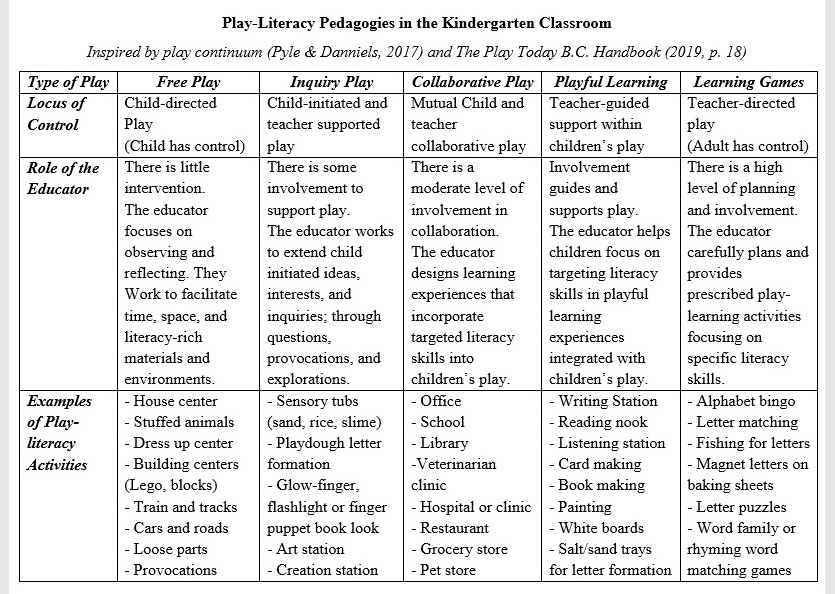
Local Frameworks and Supporting Documents
As research continues to make contributions, perspectives of play continue to evolve and so do early learning practices, policies, and supporting documents. There are several frameworks in British Columbia that support and guide play pedagogies in early learning environments, including the B.C. Early Learning Framework (2019) and The Play Today B.C. Handbook (2019). The B.C. Early Learning Framework (2019) states that play is essential to children’s growth, well-being, and learning. This framework calls for educators to broaden meanings associated with play to enrich perspectives and enhance practices, in order to create high quality learning programs. “Play can be individual, collective, spontaneous, planned, experimental, purposeful, unpredictable, or dynamic….Play is an approach to inquiry, a way to research the world. By providing diverse materials and experiences, educators create spaces for experimentation and transformation” (p. 24). This framework describes communication and literacies as living inquiries; which are ongoing, constantly evolving, multifaceted, non-linear, and dynamic. The framework offers pathways for engaging students with communication and literacies, including using multiple modes of communication; connecting culture, family, traditions, and knowledge; working to extend vocabulary, symbols, and written language; using sound and word play; and integrating technology (p. 66). Some examples include play dance, movement, construction, art, music, storytelling, and technology (p. 80). British Columbia educators are fortunate to have such a comprehensive map to direct their pedagogies.
The Play Today B.C. Handbook (2019) is a practical guide for offering high quality, play-based learning opportunities for children in the early years and beyond. This handbook shows educators how to effectively integrate play and learning experiences, routines, and behaviours into classroom environments. The document suggests that educators can work to negotiate a balance of play and learning by providing a diverse range of experiences along the play-learning continuum. The handbook explains that high quality programs provide important aspects of equal access, student participation, and support systems. In terms of providing equal access, this handbook recommends making language and literacy assessable to children by offering multiple forms of engagement and expression to ensure children with diverse needs succeed. Strategies to providing an inclusive program, include adapting the environment, incorporating technology, or modifying activities. In relation to participation, the handbook recommends a number of approaches, including teaching through routines, teaching through play, and varying amounts of direct instruction. With regard to supports, the handbook recommends that infrastructures are put in place to support children, families, and educators; including resources, policies, professional development, opportunities for collaboration. British Columbia educators are fortunate to have such a lively and joyful support document to inspire their practices.
Challenges of Play-literacy Learning
In the study by Pyle et al. (2018), educators expressed challenges related to implementing play-based approaches to literacy learning. Several challenges that educators identified were balance and workload. Educators indicated that they struggle with finding a balance between play-based approaches and ensuring children meet literacy curricula standards. Educators also expressed feeling overwhelmed by workload when trying to provide a diverse range of opportunities to students. Furthermore, educators described issues coping with high student-teacher ratio, as diverse student strengths and needs, demand many different learning outcomes. As a result, more research is required to determine how to negotiate a balanced Kindergarten literacy program that offers a range of rich play and learning opportunities in positive, productive, and manageable ways.
Conclusion
Today, educators are working with children, families, and communities; coming from diverse backgrounds and experiences of language and literacy, play and learning. As a result, educators must collaborate with children and families to create responsive and inclusive literacy programs that inspire play and learning for all. I look forward to future research discoveries regarding the integration of play and literacy to guide classroom practices, enhance early learning programs, and inform policies.
References:
Government of British Columbia. (2019). British Columbia Early Learning Framework. Retrieved
from: https://www2.gov.bc.ca/assets/gov/education/early-learning/teach/earlylearning/early_
learningframework.pdf
Government of British Columbia. (2019). The Play Today B.C. Handbook. Retrieved from:
https://www2.gov.bc.ca/assets/gov/education/early-learning/teach/earlylearning/play-today-
handbook.pdf
Hedges, H., Cullen, J., & Jordan, B. (2011). Early years curriculum: Funds of knowledge as a
conceptual framework for children’s interests. Journal of Curriculum Studies, 43(2), 185-205.
Mraz, K., Porcelli, A., & Tyler, C. (2016). Purposeful play. A teacher’s guide to igniting deep and
joyful learning across the day. Portsmouth, NH: Heinemann.
Neaum, S. (2018). Engaging with literacy provision in the early years: Language use and emergent
literacy in child-initiated play. Journal of Early Childhood Literacy.
Pyle, A., & Alaca, B. (2018). Kindergarten children’s perspectives on play and learning. Early Child
Development and Care, 188(8), 1063-1075.
Pyle, A., & Bigelow, A. (2015). Play in kindergarten: An interview and observational study in three
Canadian classrooms. Early Childhood Education Journal, 43(5), 385-393.
Pyle, A., & Danniels, E. (2017). A continuum of play-based learning: The role of the teacher in
play-based pedagogy and the fear of hijacking play. Early Education and Development,
28(3), 274-289.
Pyle, A., DeLuca, C., & Danniels, E. (2017). A scoping review of research on play‐based pedagogies
in education. Review of Education, 5(3), 311-351.
Pyle, A., Prioletta, J., Poliszczuk, D. (2018). The play-literacy interface in full-day kindergarten
classrooms. Early Childhood Education Journal, 46(1), 117-127.
Roskos, K. A., & Christie, J. F. (2011). Mindbrain and play-literacy connections. Journal of Early
Childhood Literacy, 11(1), 73-94.
Stegelin, D. A. (2005). Making the case for play policy: Research-based reasons to support play-based
environments. YC Young Children, 60(2), 76-85.
Bibliography
Banerjee, R., Banerjee, R., Alsalman, A., Alsalman, A., Alqafari, S., & Alqafari, S. (2016). Supporting
sociodramatic play in preschools to promote language and literacy skills of english language
learners. Early Childhood Education Journal, 44(4), 299-305.
Biordi, L., & Gardner, N. (2014). Play and write: An early literacy approach. Practically
Primary, 19(1), 6-9.
Chesworth, L. (2016). A funds of knowledge approach to examining play interests: listening to
children’s and parents perspectives. International Journal of Early Years Education, 24(3),
294-308.
Gregory, E., Long, S., & Volk, D. (2004). A sociocultural approach to learning. In E. Gregory, S.
Long, & D. Volk (Eds.), Many pathways to literacy: Young children learning with siblings,
grandparents, peers, and communities (pp. 6-20). New York: RoutledgeFalmer.
Hassett, D. D. (2008). Teacher flexibility and judgment: A multidynamic literacy theory. Journal of
Early Childhood Literacy, 8(3), 295-327.
Lester, S., & Russell, W. (2008). Play for a change: Play, policy, and practice: A review of
contemporary perspectives. London: Play England.
Lillemyr, O. F., Søbstad, F., Marder, K., & Flowerday, T. (2011). A multicultural perspective on play
and learning in primary school. International Journal of Early Childhood, 43(1), 43-65.
Wood, E. (2016). Understanding complexity in play through interpretivist research. The SAGE
Handbook of early childhood research. SAGE Publications, Ltd.
Wood., E. (2014). Free choice and free play in early childhood education: troubling the discourse.
International Journal of Early Years Education, 22(1), 4-18.
Wood, E. (2013). The play-pedagogy interface in contemporary debates. In L. Brooker, M. Blaise, &
S. Edwards (Eds.), The SAGE handbook of play and learning in early childhood (pp. 145–156).
Thousand Oaks, CA: Sage.
Wood, E. (2010). Developing integrated pedagogical approaches to play and learning. In P.
Broadhead, J. Howard, & E. Wood (Eds.), Play and learning in the early years (pp. 9–26).
Thousand Oaks, CA: Sage
Sociocultural Approaches to Free Play in Kindergarten: Understanding Play through Children and Understanding Children through Play
Carla Montie
December 1, 2019
UBC Faculty of Education
EDUC 585E-61A
Instructor: Iris Berger
Introduction
I have always been passionate about play, in both my personal life and my professional life. My early childhood experiences of play were formative and memories of play will always have a fond place in my heart and mind. Throughout my life, the importance of play has continued in many different forms, including playing and coaching sports and engaging in play-based hobbies such as hiking, skiing, canoeing, archery, mountain biking and agility training with my dogs. Now as a teacher, I ask myself, what kind of experiences and memories of play do I want to share with my students?
Many educators, parents, academic researchers and advocates for children’s rights agree that play is vital for young children. However, how do we know what constitutes play? Although play is considered to be a universal or desirable phenomenon of childhood, there are variations in meaning, form, and context. The concept of play is socially constructed and varies based on cultural norms, values, and beliefs. In addition, ideas and actions of play are formed by a variety of dynamic social, cultural, and political elements that are interconnected and constantly changing. Children are co-constructors of culture as they engage with people, places, objects, and ideas. In play cultures, children are players and participants; they are creators and collaborators. Children use play to express ideas, identities, interests and inquiries. Children also use play to explore cultural context and make sense of the world around them. Therefore, children can provide valuable insight into the world of play; and conversely, play can provide insight into the lives of children.
While learning about sociocultural theories of early childhood education this term, I realized that I would like to explore social and cultural constructions, components, and implications of free play, in the classroom. Some guiding questions, include: (1) What does free play mean from a sociocultural perspective? (2) How are ideas and actions of free play constructed by children, educators, social structures, greater cultural contexts and political climates? (3) What can children tell us about free play? (4) What can free play tell us about children? (5) How can educators use free play to support the diverse contexts, interests, inquiries, and needs of children, in a classroom context? This paper will explore sociocultural approaches to understanding free-play, in a Kindergarten classroom context. The organization of this paper will consist of: (Part 1) Literature Review; (Part 2) Professional Implications; and (Part 3) References.
Review of the Literature
In a review of the literature, I will use sociocultural perspectives to explore social and cultural aspects of free play, in a Kindergarten context. I have organized the literature review into the following four themes: (1) definitions of free play; (2) social and cultural complexities and diversities of free play; (3) children’s interests and inquires, working theories, and funds of knowledge in free play; and (4) social and cultural equity: power relations and dynamics of free play.
Definitions of Free Play
Research regarding definitions of play has been a popular topic of discussion and debate for years. Collecting information concerning meanings and actions of free play not only contributes to research on the topic, but also guides educational practices and policies. Continuing to develop understandings of free play is an important step in establishing foundations of knowledge to build pedagogies on. This process can enrich educator’s views of free play in order to enhance pedagogies that integrate, inspire, and support free play in the classroom.
A study by Pyle and Danniels (2017) provided some definitions of free play. This study explored play in 15 public Kindergarten classrooms, in three school districts, in Ontario, Canada. According to Pyle and Danniels (2017), the term free play is usually used to describe play that is child-centered, voluntary, spontaneous, flexible, and often involves pretend play or many other types of play. The authors explained that free play is the most child-directed form of play because the locus of control is with the child. Free play is child-initiated, and is related to interests or inquiries of the individual child or group of children (Pyle & Danniels, 2017). This study used qualitative methods to collect data, including observations and teacher interviews. While the information presented in this study provides a starting point to defining free play, it does not take into account complexities and diversities of free play. One challenge to this study is that children’s perspectives were not included in the research. Furthermore, this study offers a working definition of free play in the context of Ontario, Canada. As a result, this data represents a simple and homogenous view of free play, based in a Western cultural setting. However, this study does not investigate free play in other cultural contexts. More research is needed to investigate children’s perspectives of free play and to explore alternate definitions of free play in different cultural contexts.
In another study by Pyle and Alaca (2018), research was conducted from Kindergarten children’s perspectives on play and learning. Research about play has been predominantly conceptualized from adult perspectives. As a result, little is known about children’s views of their play experiences. This lack of children’s perspectives has been an area of concern for researchers, parents, educators, and policy makes. “Considering that children are key agents in classroom play contexts, it is important to understand their views on play and learning” (Pyle & Alaca, 2018, p. 1063). By conducting research with children as participants, this study offered a much-needed approach to research about play. The goal of this study was to explore children’s perspectives on the connectedness of play and learning and how these views are related to types of play that exist in their classroom setting. Ten Kindergarten classes were selected, in Ontario, Canada. Photo elicitation interviews were conducted with 134 Kindergarten students, and 10 hours of observation occurred in each classroom. Researchers found that in the 10 classrooms, free play was the most common form of play observed. Free play included a variety of activities such as building, toy bins, sensory play, painting, and house center. Results indicated that children’s understandings of connections between play and learning were related to teacher presence in play; communication of the purposes, values and roles of play; and the types of play environments set up in the classroom. “In classrooms where opportunities to engage in varied types of play were provided, the students expressed the perspective that play and learning were connected. In classrooms where free play was the dominant form of play, the students expressed the perspective that play and learning were distinct construct” (Pyle & Alaca, 2018, p. 1071). Findings from this study revealed that children have dynamic understandings of play that are connected to classroom context. This study provided valuable insight into children’s perspectives of play, learning, classroom environments, class community, and class culture. However, further research involving children’s perspectives in different cultural contexts is required to continue to enhance understandings of the complexities and diversities of free play.
Social and Cultural Complexities and Diversities of Free Play
Sociocultural perspectives call us to question our own personal contexts, as well as ideals rooted in dominant Western cultural traditions. It is essential for educators to be aware of social and cultural aspects in order to challenge taken-for-granted values, beliefs, and biases of free play. This awareness involves examining assumptions about free play that could be participating in expectations, untruths, or inequities in the classroom. Challenging homogenous or simplistic representations of free play honours and celebrates the diverse realities of the world’s cultures and children. What does free play mean within my community, in other communities, across the county, around the world, in minority groups, and in First Nations communities? What does free play mean to different educators, children, families, communities and cultures? How can dominant views of free play be challenged?
Sociocultural approaches include exploring social constructions of free play, the social and cultural elements that are at work in the process of these constructions, and the diversities that exist in various social constructions. Woodhead’s social and cultural perspective (2006) emphasized three main themes: “(i) diversities in early childhood; (ii) development is a social and cultural process; (iii) early childhood is socially constructed” (p. 18). I have adapted these themes (Woodhead, 2006) to consider free play from a social and cultural perspective; including diversities in free play, free play is a social and cultural process, and free play is socially constructed. First, exploring diversities of free play allows for a broader, more authentic understanding of individual and collective forms, varieties, and norms that exist. “For early childhood experts rooted in Western cultural traditions and values…these descriptions are full of culture specific assumptions…[that] homogenize ‘children,’ making no allowance for individual differences…[or] any other aspects of diversity” (Woodhead, 2006, p. 17). Respecting diversities within and between societies contributes to understandings of what constitutes contextually appropriate, natural, or beneficial forms of free play. Secondly, free play is a common phenomenon that exists for many children, in many contexts, all over the world. However, a social and cultural perspective points out that it is a social and cultural process. Children “…learn to think, feel, communicate and act within social relationships in the context of particular cultural settings and practices…” (Woodhead, 2006, p. 22). Children act and react to free play within the context of their environment; influenced by people, social factors, and greater cultural and political contexts. Lastly, meanings and understandings of free play are socially constructed. These constructs are ambiguous formations that are constantly changing within a given time and place. Free play has been understood differently in different societies, parts of the world, and periods of history. Researching free play across different children, communities, cultures, time and space can contribute a variety of perspectives, and can lead to inclusive understandings and pedagogies of free play in classrooms.
Interpretivist research has also revealed detailed insights into the complexities and diversities of free play, based on sociocultural contexts. Wood (2016) examined culturally responsive ways of understanding play through interpretivist methods. Dominant discourses of natural or normalized childhoods often view play as a means to promote ‘typical’ development, health, well-being, or educational pathways. “In contrast, interpretivist ontology and epistemologies offer scope for understanding variations within and across contexts, and cultural-historical influences on children’s play repertoires” (Wood, 2016, p. 5). Portraying a range of social constructions of free play including different children, families, communities, and cultures is a way to contribute diverse perspectives, provide understandings to different contexts, and contest dominant narratives of play. This includes recognizing a variety of free play types, such as outdoor play, risky play, rough and tumble play, dramatic play, and play topics that are deemed culturally inappropriate or taboo (for example, death, politics, religion, gender, race, etc.). “Such insights provoke a challenge to more idealized and sanitized views of children’s play where the exhortation to ‘play nicely’ is often invoked as a means of adults controlling approved forms of play” (Wood, 2016, p. 7). Furthermore, children act as knowledge users and knowledge makers as they act and create through free play. “The challenge for interpretivist research is to reveal the ‘small narratives’ of children’s play and to appreciate their wider significance, not just for developmental or educational progress, but for understanding play for its own sake and in its own right, and for understanding how children invent and perform their own childhoods” (Wood, 2016, p. 5). One caution of engaging in interpretivist research is that it involves an ongoing process of ethical reflexivity. This process must involve cultural relativism by considering cultural context and relevant values about children, childhoods and play. More interpretivist research is needed, in different cultural settings, in order to contribute diverse and detailed understandings of free play.
Children’s Interests, Inquiries, Working Theories, and Funds of knowledge
Educators have the challenge of finding meaningful ways to support play, learning, and growth among diverse groups of children. A funds of knowledge approach to education explains that teachers should draw upon their own and others’ interests, inquiries, working theories, and funds of knowledge to enhance pedagogies in the classroom. Free play can be a relevant and powerful way to provide children with opportunities to access these elements in a fun, engaging, and motivating context.
Hedges, Cullen, and Jordan (2011) define the term children’s interests as “…children’s spontaneous, self-motivated play, discussions, inquiry, and/or investigations that derive from their social and cultural experiences” (p. 187). This study explored the nature of children’s interests in relation to children’s experiences and funds of knowledge. It also examined how teachers work to construct curriculum by realizing and engaging with children’s interests and inquiries. This study took place in two early-childhood settings, in New Zealand, and used interpretivist methodology and qualitative approaches in order to generate data. The findings from this study indicated that interests and inquiries are inspired by children’s funds of knowledge, which are formed during participation in everyday life experiences. As a result, educators need to move beyond basic notions of the “…well-resourced, child-centered, play-based environment to interpret and respond to children’s interests” (Hedges et al., 2011, p. 186). Furthermore, educators need to engage more actively and authentically with children, families, and communities in order to gain deeper understandings of interests. This approach can be used to support children’s interests and inquiries by providing elements in the play environment that help access, extend, and challenge children’s funds of knowledge. Using a funds of knowledge approach, can provide educators with a way to recognize and respond to children’s ideas, interests, and inquiries in order to support play-based pedagogies in the classroom.
Classroom environments are potentially rich meeting places for children, families, and teachers from diverse backgrounds to connect, play, learn, share, and interact. Free play in the classroom can be a method for educators to recognize and respond to the interests, inquiries, and funds of knowledge of children. How do children’s interests emerge from the everyday realities of homes, classrooms, and communities? Chesworth (2016) pointed out that interpretations of children’s interests often focus on individual choice in engagement with materials and activities in play environments. However, sociocultural perspectives view interests as a collaborative process. Interests are co-constructed when community members participate in collective social and cultural practices. This paper reported on selected data from a larger study (Chesworth, 2015), which focused on the play of five key children and their peers, in a reception class, in England. Chesworth (2015) aimed to understand play through perspectives of children, their parents and teachers. This study (Chesworth, 2015) used a version of video-cued ethnography, by filming play episodes of free play and then using the filmed material as provocation for children, parents, and teachers to share their perspectives. Chesworth (2016) argued that “…participation in sociocultural activity generates interests informed by funds of knowledge that children reconstruct in their play” (p. 294). Chesworth (2016) explained that a critical understanding of how children’s diverse experiences inform individual and collective interests can provide valuable interpretations of play. This report was small-scale and culturally specific in nature, however it provided valuable insights into the views of children. More research conducted in this way would be valuable to explore children’s perspectives in a variety of diverse cultural settings.
Sociocultural approaches can combine concepts of interests and inquiries, funds of knowledge, and working theories to provide complex and diverse theories of free play. Children’s funds of knowledge, interests and inquiries develop into working theories that are the drivers of play and learning, as children make sense of the world around them. These working theories are constantly changing as children work individually and collectively to construct and reconstruct meaning. Hill and Wood (2019) was an ethnographic case study that explored how children build and use working theories in play. Research was conducted with a Kindergarten class of 20 children, in an international school, in Switzerland. This study used video recordings of play episodes and post-video discussions with children and parents. Findings demonstrated that children’s interests and working theories are sources of peer-led learning in the form of play. The authors explained that educators need to understand and utilize children’s interests, inquiries, and working theories to support meaningful, powerful, and relevant play. “The relationship between experiences and interests in fluid and dynamic as new experiences drive new interests, and vice versa” (Hill & Wood, 2019, p. 9). More research conducted in this way is needed to highlight children’s perspectives and explore diverse cultures.
Social and Cultural Equity: Power Relations and Dynamics of Free Play
It is widely accepted that curriculum planning should incorporate children’s interests to inspire motivating and engaging learning opportunities. Furthermore, play-based learning environments support children’s overall development, health, and well-being. I used to view free play in the classroom as an open, unbiased, equal access opportunity, providing play and learning experiences for all children. However, sociocultural approaches view free play in the context of culture, including the social structures, dynamics, and power relations that exist within it. Therefore, does free choice and free play, in the classroom, really provide freedom, equity, and equal access to all children? A wide variety of factors affects free choice and free play. Gender, ethnicity, language, social class, ability or disability; as well as exposure to educational, social or play settings influence children’s participation in free play. As a result, free choice and free play may not be as fair and free as expected.
Wood (2014) used sociocultural and post-structural theories to challenge discourses of free choice and free play in early childhood education. This is an important process because taken-for-granted assumptions about play influence practice, policy, and power on many levels. This study by Wood (2014) involved ten children in an Early Years Foundation Stage setting, in England, and used naturalistic, interpretivist methods. Research investigated children’s individual and group choices during free choice and free playtime, in order to reveal how the social dynamics of power operate within different contexts. “Group play is a complex orchestration of social, physical, cognitive, cultural, temporal and relational processes” (Wood, 2014, p. 14). These complex processes encompass more than children’s motivation to play or developmental needs; play can act as an expression of individual identities and interests, peer cultures and interests, social and cultural elements, and “…a testing ground for whose freedom, power and control can be exercised” (Wood, 2014, p. 16). In the classroom, power relationships exist between children, between children and adults, and between participants and social rules. Furthermore, in educational settings, free choice and free play are controlled by peers, teachers, classroom environment and materials, policies, culture norms, and political structures. Teachers typically define what choices are available, what freedoms are allowed, what rules and boundaries are in place during free play, free choice, and general classroom behaviour. What types of play are valued, accepted, and encouraged? What types of play are forbidden, restricted, or controlled? What needs, choices, and interests are exercised or marginalized through free play? As a result, it is extremely important to acknowledge the complexity of children’s experiences and the power relations that exist in children’s play. Wood (2014) called for educators “…to be aware of the children’s repertoires of choice, specifically the ways in which the freedom to choose may advantage some, but disadvantage others” (Wood, 2014, p. 16). By raising questions and becoming aware of the social, cultural, and political dimensions and power dynamics of play cultures, we can work towards supporting equity for all children, in play endeavours.
Professional Implications
While learning about sociocultural theories this term, I became inspired to understand how free play can be a window into the lives of children; and how children’s perspectives can be a view into the world of free play. I now understand the importance of observing children in free play and listening to children’s perspectives to guide play pedagogies in the classroom. I now also understand the importance of exploring how free play opportunities, experiences and environments can be used to support and include all children and their unique contexts. “Early learning environments are enrolling more students with diverse learning needs…educators want to support diverse communities of learners…Play is a powerful tool for educators who support diverse learners as it capitalizes on child interest and peer engagement” (The Play Today B.C. Handbook, 2019, p. 35).
Today educators are living and teaching in diverse communities that include children and families from a wide variety of cultures. Sociocultural approaches focus on building nurturing, responsive, and inclusive climates that promote the holistic and healthy well-being of all children. These approaches recognize that each child brings a unique context, containing social and cultural components, as well as strengths and needs. “Each child has histories, contexts, gifts, capabilities, and potential that can be honoured and nurtured with responsive and productive practices and environments” (B.C. Early Learning Framework, 2019, p. 25). Early childhood educators have an important role to support all children to explore identity, interact socially, establish relationships, and feel a sense of belonging within the class community. “Regardless of socio-economic status, geographic isolation, gender, sexuality, ethnicity, abilities and learning needs, and family structure and values, every child should be welcomed and empowered to pursue their gifts” (B.C. Early Learning Framework, 2019, p. 25). Free play can be a powerful, motivating, and meaningful way for children to engage and explore; and to construct and reconstruct culture.
Canada’s National Accord on Early Learning and Early Childhood Education (Franklin, McNinch & Sherman, 2013) provided twelve key principles to guide practice in early learning environments. I will use these principles to consider how I can use free play to support all children and families in my Kindergarten classroom:
(1) “Early learning education focuses on the whole child” (p. 6). Therefore, free play can provide opportunities for children to express their holistic contexts by drawing upon personal, social, cultural, and linguistic components.
(2) “Children are capable and ready to learn, and should be viewed as full of potential” (p. 6). Free play can celebrate the fact that children are competent and capable by allowing them to have freedom, make choices, make mistakes, learn, create and collaborate through play.
(3) “Adults are ethically responsible for ensuring the health and well-being of children” (p. 6). Primarily, it is the educator’s duty to facilitate physical and emotional safety during free play. As a result, educators must be aware of subtle aspects of power inequities, relations, and dynamics in order to support social and cultural equity among children and between children and adults.
(4) “Families and community are valued and respected” (p. 6). Children’s unique contexts include connections to family, community and culture. These aspects need to be valued, respected, and represented in class culture and in free play.
(5) “Curricula are responsive to children and families” (p. 7). To facilitate equity and equal access to free play, educators must ensure the class environment includes children’s and families’ interests, inquires, working theories, funds of knowledge, and linguistic and cultural aspects.
(6) “Supportive relationships and interactions between teachers and children are valued and nurtured” (p. 7). Free play provides children with opportunities to develop social skills. It is the educator’s role to support positive interactions and relationships in free play. As a result, teachers may need to guide students, scaffold social skills, and support free play when help is required.
(7) “Early learning educators and environments provide meaningful and relevant opportunities for young children to interact with one another” p.7). Free play content and environments must be set up to invite children to connect and interact with peers in real and authentic ways.
(8) “Early learning educators, appropriate environments, and community resources engage the minds of young children” (p. 7). Free play practices, resources, and environments should provide children with learning opportunities to explore and investigate through play.
(9) “Early learning takes into account a wide range of philosophical, pedagogical, and theoretical approaches that inform policy and practice” (p. 7). Educators should aim for holistic, balanced, and eclectic approaches to free play pedagogies.
(10) “Early learning educators engage in care-full documentation of student learning and their own teaching” (p. 7). The learning processes, assessments, and documentations of free play must include practices that celebrate multiple languages and cultural identities.
(11) “Diversity and social responsibility are valued” (p. 7). Free play in the classroom values inclusion, equity and democratic practices that offer children opportunities for voice and choice; interdependence and dependence; co-operation and collaboration.
(12) “Policy and practice in early learning are informed by current educational research, knowledge, and appreciation of this field as critical components of public education” (p. 8). Educators must stay up to date on research in order to provide evidence-based pedagogies of free play.
Over the past 20 years of teaching experience, my play pedagogies are constantly changing to reflect my own beliefs and values; as well as the interests, inquiries and needs of my students. As The B.C. Early Learning Framework states, I teach with “…the hope of inspiring and supporting the creation of rich, joyful early childhood spaces where children, adults, ideas, and materials come together, and where knowledge is constructed about learning and living in ways that are local, inclusive, ethical, and democratic (2019, p. 11). I feel honoured to be teaching in a time that offers many rich theories to draw upon. I look forward to what new theories will have to offer in the future.
References:
Chesworth, L. (2016). A funds of knowledge approach to examining play interests: listening to
children’s and parents perspectives. International Journal of Early Years Education,
24(3), 294-308.
Franklin, K., McNinch, J., & Sherman, A. (2013). Accord on Early Learning and Early
Childhood Education. © Association of Canadian Deans of Education.
Government of British Columbia. (2019). British Columbia Early Learning Framework. Retrieved
from: https://www2.gov.bc.ca/assets/gov/education/early-learning/teach/earlylearning/early_
learningframework.pdf
Government of British Columbia. (2019) The Play Today B.C. Handbook. Retrieved from:
https://www2.gov.bc.ca/assets/gov/education/early-learning/teach/earlylearning/play-today-
handbook.pdf
Hedges, H., Cullen, J., & Jordan, B. (2011). Early years curriculum: Funds of knowledge as a
conceptual framework for children’s interests. Journal of Curriculum Studies, 43(2), 185-
205.
Hill, M., & Wood, E. (2019). ‘Dead Forever’: An ethnographic study of young children’s
interests, funds of knowledge and working theories in free play. Learning, Culture and
Social Interaction, 23.
Pyle, A., & Alaca, B. (2018). Kindergarten children’s perspectives on play and learning. Early
Child Development and Care, 188(8), 1063-1075.
Pyle, A., & Danniels, E. (2017). A continuum of play-based learning: The role of the teacher in
play-based pedagogy and the fear of hijacking play. Early Education and Development,
28(3), 274-289.
Wood, E. (2016). Understanding complexity in play through interpretivist research. The SAGE
Handbook of early childhood research. SAGE Publications, Ltd.
Wood, E. (2014). Free choice and free play in early childhood education: troubling the
discourse. International Journal of Early Years Education, 22(1), 4-18.
Woodhead, M. (2006). Changing perspectives on early childhood: theory, research and
policy. International Journal of Equity and Innovation in Early Childhood 4 (2), 1-43.
Bibliography:
Gregory, E., Long, S., & Volk, D. (2004). A sociocultural approach to learning. In E. Gregory, S.
Long, & D. Volk (Eds.), Many pathways to literacy: Young children learning with
siblings, grandparents, peers, and communities (pp. 6-20). New York: RoutledgeFalmer.
Hedges, H. (2014). Young children’s working theories’: Building and connecting
understandings. Journal of Early Childhood Research, 12(1), 35-49.
Hedges, H. (2015). Sophia’s funds of knowledge: Theoretical and pedagogical insights,
possibilities and limitations. International Journal of Early Years Education, 23 (1) 83-
96.
Lester, S., & Russell, W. (2008). Play for a change: Play, policy, and practice: A review of
contemporary perspectives. London: Play England.
Mraz, K., Porcelli, A., & Tyler, C. (2016). Purposeful play. A teacher’s guide to igniting deep
and joyful learning across the day. Portsmouth, NH: Heinemann.
Pacini-Ketchabaw, V. (2011). Rethinking developmental theories in child and youth care. In A.
Pence & J. Little (Ed.s), Child and youth care: Critical perspectives on pedagogy,
practice, and policy (pp. 19 – 32).
Purcell-Gates, V., Lenters, K., McTavish, M. & Anderson, J. (2014). Working with different
cultural patterns and beliefs. Multicultural Education; 21 (3/4), 17-22.
Pyle, A., & Bigelow, A. (2015). Play in kindergarten: An interview and observational study in
three Canadian classrooms. Early Childhood Education Journal, 43(5), 385-393.
Pyle, A., & Danniels, E. (2017). A continuum of play-based learning: The role of the teacher in
play-based pedagogy and the fear of hijacking play. Early Education and Development,
28(3), 274-289.
Pyle, A., DeLuca, C., & Danniels, E. (2017). A scoping review of research on play‐based
pedagogies in education. Review of Education, 5(3), 311-351.
Creating Play Experiences and Environments that Support the Development of Social Skills
Carla Montie
July 14, 2019
UBC Faculty of Education
EDED 530 97A
Instructor: Lara El Khatib
Introduction
While learning about typical and atypical social development and some disorders, I realized that I would like to know more about how I can facilitate play experiences and environments that support social skill development in all children, and particularly in children with special needs or disabilities. An ecological approach focuses on building a nurturing, responsive, and inclusive environment and climate that promotes healthy development of all children. “The development of positive social skills is critical to the successful inclusion of children with disabilities in community-based settings” (Cook, Klein & Chen, 2020, p. 210). A strength-based approach recognizes that each child brings gifts. “Each child has histories, contexts, gifts, capabilities, and potential that can be honoured and nurtured with responsive and productive practices and environments” (Early Learning Framework, 2019, p. 25). Early childhood educators have an important role to support children with specials needs or disabilities so they can play, interact socially, establish relationships with their peers, and feel a sense of belonging within the class community. “Inclusion entails recognition of our universal oneness and interdependence. Inclusion is recognizing that we are one even though we are not the same” (Asante, 2002, p.1). Play can be a powerful, motivating, and meaningful way for children to develop positive and productive social skills.
The inspiration for this reflection paper comes from a Grade 2 student at our school, named Kyla (pseudonym), who has a rare disorder caused by chromosomal abnormalities. This past school year, Kyla spent time in my Kindergarten classroom each day to gain additional play opportunities to support personal growth and development of social skills. Several aspects influence Kyla’s ability to actively participate in play, interact with peers, and engage in social behaviours. Kyla exhibits developmental delays in all areas of development, including conceptual (cognitive functioning), social (social/emotional) skills, and practical (adaptive) skills. Kyla has limited language and communication skills, she is non-verbal, avoids eye contact, and has difficulty reading nonverbal cues. Kyla’s lack of fine-motor and gross-motor skills impact her play choices and play behaviours. During playtime, Kyla shows limited joint attention and imitation of others. She does not engage in symbolic play and typically participates in repetitive play with the same objects. Children like Kyla, with special needs or disabilities, will need adult and peer assistance to participate in play and social endeavours. I think we did a good job of providing Kyla with play opportunities to encourage positive interactions and social experiences. However, new information I learned in lessons 9 and 10, have influenced my perspectives, moved me in new directions, and generated new questions and inquiries. Next school year Kyla will continue to spend time in my Kindergarten class, therefore I would like to review and reflect on past practices in order to make improvements for next year. The ultimate goal is that all my students can equally access age and context appropriate opportunities for health, happiness, well-being, and optimal development.
I will be using the process of Connect-Extend-Challenge to enhance my understanding of creating play experiences and environments that support the development of social skills for all children in my Kindergarten class; and especially for children, like Kyla, with special needs or disabilities. The organization of this paper will consist of: (1) connecting what I learned to previous knowledge and experience; (2) extending my learning by reflecting on how this knowledge has changed my way of thinking and caused me to move in new directions; and (3) challenging my understanding by addressing any issues, topics, or questions that continue to contest my pedagogy.
Connect
Many educators consider social skills to be one of the most important developmental areas for children. “Social skills form a multidimensional construct” (Szumski, Smogorzewska & Karwowski, 2016) and as a result there are various definitions. However, social skills can be defined as competent abilities and behaviours that facilitate interaction and communication with others (Szumski et al., 2016). In my Kindergarten class community, social skill development and positive peer interactions are something that I aspire to encourage and promote for all of my students. Therefore, I think it is important to review my current pedagogy; to connect, reflect, and re-evaluate practices in order to enhance my program.
I have always greatly valued the power of play in my Kindergarten classroom. Play can act as a platform to encourage social interactions and develop social skills. Play naturally has great potential to inspire connection, collaboration, cooperation, and inclusion, in a way that is engaging and motivating to children. The multifaceted and malleable nature of play allows for differentiation; the ability to transform, evolve, adapt and modify activities.
There is considerable literature on the importance of play in early childhood settings. Extant research has shown that play can be used for developmental learning and can positively influence children’s development of social skills (Pyle & Danniels, 2017). In education systems all over the world, the value and benefits of play approaches have been acknowledged, explored, and endorsed in both research and educational contexts. In Canada, educational policies and curricula have been changing to acknowledge evidence-based practice promoting play as developmentally appropriate and necessary pedagogy (Pyle & Danniels, 2017). Locally, there are several new mandates for play and play-based learning in early childhood settings. In British Columbia, some examples include The Play Today B.C. Handbook (2019), the B.C. Early Learning Framework (2019), and the B.C. Curriculum and Core Competencies (2019). The Play Today B.C. Handbook states: “The experiences of children’s play have a profound impact on all areas of their growth and development” (2019, p.1). In addition, the B.C. Early Learning Framework states: “This framework values play as vital to children’s learning, growth, and meaning making” (2019, p. 27). My Kindergarten program highly values practices of play, and I regularly explore research and policy to inform, guide, and change my pedagogy.
In terms of creating play experiences and environments that support the development of social skills, I made several connections between what I already knew and what I revisited in lessons 9 and 10. The first connection I made is arranging play areas thoughtfully; and the second connection I made is establishing rules, boundaries, and guidelines from the beginning (Cook et al., 2020). In my Kindergarten classroom, I have established open play areas by providing larger spaces for cooperative play with building materials (big wooden blocks, Duplo, Mega Blocks, Connectors, etc.). I have carefully arranged small, cozy, private spaces to allow for quiet alone time (Quiet Corner, puzzle and book nook, listening station, etc.). A kitchen area is set up to promote imaginative and cooperative play. Various play materials and resources are made available to children and have effective storage places. Many imagination stimulators are available such as puppets and puppet theatre; dolls and dollhouse; dress-up (closet, mirror and area); car, truck and train table (mats, roads, tunnels, etc.); animals with a barn and farm terrain; dinosaurs; stuffed animals; as well as a variety of loose parts (natural and man-made). I utilize both inside and outside spaces to provide more choice and avoid crowding. Throughout the year, some toys take a break and are put away (into storage) if they are not compatible with the group or encourage too much noise, activity, or conflict (Cook et al., 2020). Careful, thoughtful, and flexible arrangements of the classroom space allow the environment to work as a ‘third teacher’ and support children to access play and social opportunities.
Over the years, I have learned that it is an important investment to establish rules, boundaries, and guidelines from the beginning of the school year. Some ideas that I connected to and already implement in my own classroom include keeping rules simple and concise, allowing children time to learn the rules by observation and experience, and using teachable moments to remind children and reinforce rules. Rules in my classroom are meaningful and gentle. They celebrate kind behaviour such as respecting others; promoting voice, choice, and free-will; encouraging but (not forcing) sharing; using good manners; returning objects back to their place when done; asking permission to join in; honouring someone’s desire to observe, sit out, or have quiet alone time (Cook et al., 2020). I find that this process provides children with structure, security, and stability to feel safe and take risks when engaging in play and social endeavours. Providing this support is even more important for children who lack social skills, have special needs, or disabilities.
Extend
There were also several new ideas, approaches, and concepts that I learned from lessons 9 and 10 that extended and pushed my thinking in new directions. Some examples of this extension include using environmental structuring, using peers without disabilities as mediators of social skills, achieving a greater understanding of the development of social interaction skills through play, and facilitating play and social skill development in children with severe disabilities (Cook et al., 2020).
A new strategy I learned from lessons 9 and 10, and plan to use in future planning, is using environmental structuring (Cook et al., 2020). I will keep groups small during play activities so that I can help encourage and guide positive social interactions, but not disturb play. I will provide opportunities for children to learn how to use certain materials before expecting them to play in cooperative situations. I will carefully select social and cooperative materials and toys rather than isolating ones. I will plan opportunities that offer sufficient materials to encourage imitation and cooperation, or less – if the goal is to promote sharing. I will plan collaborative activities to practice cooperation and imitation skills. Structuring the environment in these ways, offered by Cook et al. (2020) will enhance interactions, lead to positive and productive play, and support the development of social skills.
Another strategy I learned is using peers without disabilities as mediators of social skills. “With peer-mediated strategies, coaching is provided to a peer to promote social interaction skills rather than having only adults prompt the child with disabilities” (Cook et al., 2020, p. 211). This year we used Kindergarten peers in my class to help interact with and model social skills to Kyla. However, these specific points will provide me with important factors to consider when selecting the right peers to act as mediators. I learned that it is important to select a child who consistently follows the teacher’s directions, demonstrates positive and appropriate interactional skills, attends school regularly, frequently plays with the same toys or engages in the same activities as the child who needs intervention, and has expressed interest in interacting with the target child (Cook et al., 2020). These guidelines offer assistance in selecting peer helpers for Kyla, and other children, in the future.
In addition, information in lessons 9 and 10 helped me achieve a greater understanding of the development levels of social play behaviour. Cook et al. (2020) discuss a variation of the classic work of Parten (1932) concerning six levels of social participation. Although Cook et al. (2020) point out that it is important to follow such constructs with caution, it does provide guidelines for observing and selecting appropriate intervention strategies. The stages of play development and social participation include: (1) unoccupied behaviour, solitary independent play, onlooker behaviour, parallel activity, associative play, and cooperative or organized play (Cook et al., 2020). Kyla demonstrates the first four stages of social play development, and is able to participate in parallel play activities. However, I have not observed her engage in associative play or cooperative play. Cook et al. (2020) suggested some specific strategies I can use to support Kyla, and other students, in the future. One strategy is to identify preferences for peers and toys in order to provide opportunities for imitation of play actions and turn taking. I addition, I can use peers without disabilities to act as initiators of social interactions, such as sharing. Furthermore, I can position Kyla, or other children with special needs or disabilities, centrally within the group to provide access to toys and peers. I also learned that it is important to understand the normal progression of play development, as children with disabilities usually progress more slowly through the same stages of play and social participation. However, in order to provide optimal support or intervention; it is vital to carefully observe, examine, and understand specific differences and unique elements in each child’s play behaviour (Cook et al., 2020).
It is essential that early education works to create a responsive and inclusive environment that facilitates play and social skill development for children with disabilities. I learned that there are some specific strategies that I can use to use to support children with special needs disabilities access play (Cook et al., 2020). Primarily, I must remember that children with disabilities are children first, and need play to learn, develop and grow. Secondly, I can work to individualize play experiences by modifying materials, resources, and environments. In addition, I can intervene by encouraging and supporting play when children are not able to initiate. As a class, we can discuss that all children have the ability to participate in play, although it may look and feel different for each of us. Furthermore, I can encourage additional opportunities for play experiences (play dates, playgroups, activities, etc.). When appropriate, I can use assistive technology to support play participation. These tactics (Cook et al., 2020) offer a strength-based approach that can be used to support, adapt, and modify play and social skill development for children based on their unique strengths, interests, and needs.
Challenge
Some topics, issues and questions that continue to challenge my thinking and understanding of how I can help facilitate play experiences and environments that support social skill development for all children, and especially for children with special needs and disabilities include:
Roles of Teachers and Adults:
– What do I view my role to be, in helping children who need support playing, interacting with peers, or developing social skills?
– How do I support all my students’ diverse needs? What specific skills and strategies do I have and what do I need to learn in order to support my students?
– How do I know when to take on a passive or more active role when supporting?
Roles of Peers:
– What do I view the role of peers to be in helping support, mediate and model play, peer interactions, and social skills?
– How will I find time to train and coach peers to help students in need? How will I devise a plan for peer training? What will this plan look like?
Social Skill Teaching or Intervention Programs:
– Can social skills be taught directly and explicitly to children? Could the class engage in large or small group direct instruction time to learn a specific social skills and then be given time to practice the skill through play?
– What specific social skills would I like to target? How will I target specific social skills?
– What would a whole group social skills intervention program look like? What adaptations or modifications could be made for children that need social skill support, have special needs, or disabilities?
Social Skill Measurement (Formative and Summative Assessment):
– How will social skills be measured? How will a child’s social skill change (growth and development) be measured (assessed or gauged)?
– How do I know if social skill development is happening in my classroom? How do I know if social skill development strategies are working? What do I do if strategies are not working? How will I use this information to make changes to my plans?
– What about student self-assessment of social skills? How do I take student ideas and feelings into account for future learning and plans?
Play Opportunities:
– How do I find enough time each day for play opportunities?
– How do I ensure that I am offering a diverse range of play activities to offer variety (such as; spontaneous play, free-choice/child directed play; collaborative play; teacher-directed play; playful learning, learning games, etc.)?
– What are some specific examples of social skill activities for each type of play?
Play and Social Skill Resources:
– What other toys, materials, resources, and structures are needed to encourage play, peer interaction, and social development?
– What other community resources can I utilize to support students (community center, sports programs, nature camps, art classes, etc.)?
I have some more work to do to continue to explore these questions, and perhaps new questions, issues, and challenges will come up along the way. However, I feel confident that I have the skills and ability; intuition and experience to work through obstacles in order to make play experiences and environments and social interactions meaningful and authentic for each unique group of children and for each individual child.
Conclusion
Information I learned in lessons 9 & 10 enhanced my understanding of how to provide all of my children with equal access to meaningful powerful play, positive social interactions, and effective social skill development. “Regardless of socio-economic status, geographic isolation, gender, sexuality, ethnicity, abilities and learning needs, and family structure and values, every child should be welcomed and empowered to pursue their gifts” (Early Learning Framework, 2019, p. 25). I found this exercise to be rewarding, and in the future, I plan to continue to engage in this Visible Thinking routine to provide ongoing insight and enhancement to the work in progress of my pedagogy. Reflective practices such as Connect-Extend-Challenge can help me continue to work towards incorporating approaches that are equitable, inclusive, and child-centered; focusing on the unique context of each child. As “[t]he goal of inclusion requires educators to consider creating physical spaces, routines, or approaches that will allow each child to participate, to think, and to discover in his or her unique ways” (Early Learning Framework, 2019, p. 25).
References:
Asante, S. (2002). What is inclusion? Toronto: Inclusion Press.
Cook, R. E., Klein, M. D., & Chen, D. (2020). Adapting early childhood curricula for Children with
special needs (Tenth ed.). Pearson.
Government of British Columbia. (2019). British Columbia Early Learning Framework. Retrieved
from: https://www2.gov.bc.ca/assets/gov/education/early-learning/teach/earlylearning/early_
learningframework.pdf
Government of British Columbia. (2019). The Play Today B.C. Handbook. Retrieved from:
https://www2.gov.bc.ca/assets/gov/education/early-learning/teach/earlylearning/play-today-
handbook.pdf
Pyle, A., & Danniels, E. (2017). A continuum of play-based learning: The role of the teacher in
play-based pedagogy and the fear of hijacking play. Early Education and Development, 28(3),
274-289.
Szumski, G., Smogorzewska, J., & Karwowski, M. (2016). Can play develop social skills? the effects of
‘play Time/Social time’ programme implementation. International Journal of Developmental
Disabilities, 62(1), 41-50.
Bibliography:
Broadhead, P., Taylor & Francis eBooks – CRKN, & CRKN MiL Collection. (2004;2003;).
Early years play and learning: Developing social skills and cooperation. London;New
York;: RoutledgeFalmer.
Mraz, K., Porcelli, A., & Tyler, C. (2016). Purposeful play. A teacher’s guide to igniting deep
and joyful learning across the day. Portsmouth, NH: Heinemann.
Pyle, A., & Alaca, B. (2018). Kindergarten children’s perspectives on play and learning. Early
Child Development and Care, 188(8), 1063-1075.
Pyle, A., & Bigelow, A. (2015). Play in kindergarten: An interview and observational study in
three Canadian classrooms. Early Childhood Education Journal, 43(5), 385-393.
Pyle, A., DeLuca, C., & Danniels, E. (2017). A scoping review of research on play‐based
pedagogies in education. Review of Education, 5(3), 311-351.
Pyle, A., Prioletta, J., & Poliszczuk, D. (2018). The play-literacy interface in full-day
kindergarten classrooms. Early Childhood Education Journal, 46(1), 117-127.
Playing the Way to a Growth Mindset in Kindergarten
Carla Montie
December 3, 2018
UBC Faculty of Education
EDUC 500-61B
Instructor: Maria Pighini
Abstract
Over 30 years ago, Carol Dweck coined the terms ‘fixed mindset’ and ‘growth mindset’ to describe the underlying beliefs people have about learning and ability. Growth mindset refers to the perspective that ability can be developed through effort (Dweck, 2006). Research indicates that mindset is malleable and that adopting a growth mindset influences learning behaviours in positive ways (Dweck, 2006). This proposed quantitative study will examine the question: Can collaborative play-based learning support the development of student growth mindset in the Kindergarten classroom? Collaborative play-based learning experiences will be used in a series of intervention lessons to teach growth mindset to Kindergarten students. Four Kindergarten classes; consisting of approximately 80 students, will participate in the study. Each class will be divided into two comparison-control groups; one group in each class will receive mindset intervention through collaborative play-based learning, and the other group will engage in free-play time. This will be a pre-post design, where “before and after” data will be collected; first to measure initial student mindset, and then again four weeks later to measure if there are any changes to student mindset. Experimental methods will be used to measure the relationship between the two variables; collaborative play-based learning and growth mindset. Descriptive statistics method will be used to display time spent on student challenge activity. Content analyses will be used to measure and describe other data collected, including coded student comments and teacher or researcher observations. The significance of this proposed study is to provide existing research and teaching practice with answers and insight into the effectiveness of teaching growth mindset through a specific type of play.
Introduction
Over 30 years ago, Carol Dweck coined the terms ‘fixed mindset’ and ‘growth mindset’ to describe the underlying beliefs people have about learning and ability. Growth mindset refers to the perspective that ability can be developed through effort (Dweck, 2006). Research indicates that mindset is malleable and that adopting a growth mindset influences learning behaviours in positive ways (Dweck, 2006).
Looking into the topic of growth mindset, this proposed quantitative study will examine the question: Can collaborative play-based learning support the development of student growth mindset in the Kindergarten classroom?
Context and Background
Kindergarten has undergone significant curricular changes including increasing academic standards for young learners, in addition to mandating play-based approaches. As a result, several tensions currently exist in Kindergarten education – tensions between academic learning and play-based learning, and also between teacher-directed instruction and child-directed (student centered) learning. However, what if collaborative (guided) play could be a compromise, where the locus of control is shared to balance the extrinsic learning goal of the teacher and intrinsic motivation of the child? Collaborative play could then be used as a way to support student acquisition of both academic and developmental skills by providing students with opportunities to learn in a fun, motivating and meaningful context (Pyle & Danniels, 2017).
Since the early 2000s, there has been a shift towards the use of play-based pedagogy in Kindergarten. In education systems all over the world, the value of play-based learning approaches have been acknowledged, explored and endorsed in both research and educational contexts. Two distinct perspectives concerning the role of play have emerged; play for developmental learning and play for academic learning (Pyle, DeLuca & Danniels, 2017). “The experiences of children’s play have a profound impact on all areas of their growth and development” (The Play Today B.C. Handbook: 2019, p.1); in areas of cognition, social and emotional and self-regulation (Lester & Russell, 2008; Pyle et al., 2017). Recent advances in neuroscience show that play has a “significant role in the development of the brain’s structure and chemistry, which gives rise to emotional and physical health, well-being and resilience, as well as laying the foundation for cognitive functioning and social competence” (Lester & Russell, 2008, p. 45).
Mindset is an individual’s perception, containing a set of beliefs, attitudes and habits about learning and ability (Dweck, 2006). In her research, Dweck found that most individuals typically develop one of the two mindsets: a fixed mindset or a growth mindset, or sometimes a combination of both. Students with a fixed mindset believe that they are born with a finite set of natural abilities that are unchangeable. In contrast, students with a growth mindset believe that abilities can be developed over time with practice or effort. Students with a fixed mindset believe that ability is predetermined; therefore, they are more likely to give up when faced with difficulty because they see challenge as hardship, disappointment and failure (Mraz, Porcelli & Tyler, 2016). Students with a growth mindset believe that ability can be improved by putting in more time or effort, therefore are more likely to demonstrate persistence, determination and flexibility when overcoming setbacks because they see challenges as opportunities for leaning, growth and reflection (Mraz et al., 2016).
According to Dweck, adopting a growth mindset positively influences learning behaviour of students (Dweck, 2006). Furthermore, student mindset is malleable and can be developed and changed over time (Dweck & Yeager, 2012). Creating a classroom culture of growth mindset changes how students understand and approach learning. This collective class culture helps students develop strong work ethic and habits that can lead to students to a sense of personal satisfaction, achievement and success in a wide range of endeavors (Dweck & Yeager, 2012; Robinson, 2017).
Given the desire to promote student growth mindset and the rise of play in the Kindergarten classroom, the topic for this research proposal is, collaborative play-based learning and growth mindset in Kindergarten. The proposed research problem to be examined is, the role of collaborative play-based learning in the development of growth mindset in Kindergarten students. This topic is important because it explores how teachers can utilize play as a way to encourage growth mindset in students.
Rationale and Importance
In my years of teaching and coaching experiences, I often find myself wondering why certain children seem to have a fixed, and some seem to have a growth mindset. I also find it interesting to observe children who seem to demonstrate fixed mindset; showing that they struggle and give up in academic activities. However, these children seem to demonstrate growth mindset; showing motivation, determination and flexibility in play-based endeavours. The core of my own teaching ideology; stemming from the personal and professional experiences of my Ecosystem (Bronfenbrenner, 1994) cause me to believe that play-based learning can be used to support student development of skills by providing engaging opportunities in a joyful context. These observations and experiences have led me to the theory that play-based learning experiences can support development of student growth mindset.
The rationale of this study is based on a recommendation for Kindergarten classrooms in British Columbia to increase time spent engaging in purposeful play (The Play today B.C. Handbook, 2019), the developmental benefits of play-based learning in the Kindergarten classroom (Pyle et al., 2017), and the importance of supporting growth mindset development in young children (Dweck, 2006).
Purpose and Anticipated Significance
The purpose of this study is to gain insight into two aspects that I am passionate about within my own teaching practice: How to use purposeful play-based learning in my classroom and how to support growth mindset development in my students. I relate the purpose of this study to Arhar’s (2001) reflection on research completion. When discussing inspiration for research, Arhar explains that “[f]or those who teach, this means taking a look at something in our practice which intrigues us” (p.41). As a teacher-researcher, the purpose of this proposed study stems from a place of Action Research; a desire to explore and improve practices within my own Kindergarten classroom. My purpose as a teacher researcher is to further develop my ability to facilitate productive, positive and purposeful play-based learning for all students so that they can equally access opportunities for growth mindset development, in my current classroom setting.
The importance of growth mindset has been established and examined by a substantial existing body of research (Dweck, 2006; Dweck & Yeager, 2012). The benefits of play-based learning have been documented and explored in areas of growth and development, including; self-regulation, social and emotional skills, cognitive and overall well-being (Dweck, 2006; Dweck & Yeager, 2012; Lester & Russell, 2008). However, the role of play-based learning in the development of growth mindset has not yet been explored. Furthermore, there is a need for more research exploring specific types of play (Pyle & Danniels, 2017). The proposed research question being posed is: Can collaborative play-based learning support the development of student growth mindset in the Kindergarten classroom? Some sub questions are: What is the relationship between collaborative play-based learning and growth mindset? What happens to student mindset when growth mindset is taught through collaborative play-based learning? Can collaborative play-based learning be used to create a class culture of growth mindset in the Kindergarten classroom?
Literature Review
In a review of literature, I will explore an overview of research concerning growth mindset and play-based learning.
Review of Research about Growth Mindset
Fraser (2017) conducted a study that explored the topic of the implementation of growth mindset teaching and learning within a primary school. The aim of the research was to identify strengths and areas for development in the way that growth mindset was being applied in class and school pedagogies. Participants in this study included the head teacher, five classroom teachers, 28 students, and took place in a primary school in Scotland. Methods used in this study included observations of three different classes, semi-structured interviews with members of teaching staff, and focus groups with students. The data collected was then analyzed using an inductive approach, which entailed the researcher making observations and then looking for patterns to develop a theory (Mukherji & Albon, 2018, p. 71). Observations in this study led to four themes: “embarking on the process; classroom culture and teaching; outside the classroom; and pupil approach to learning” (Fraser, 2017, p. 1). Findings revealed some strengths, which included: staff professional development; understanding and belief of growth mindset, staff collaboration, shifts in school culture and language, and the promotion of mistake making. Areas for development included: providing more learning opportunities outside the classroom, designing compatible assessment tools and methods, and discovering ways of teaching students to respond to challenges and mistakes. Fraser pointed out that previous research on the topic indicates that one-off interventions to develop growth mindset can encourage growth mindset perspectives and practices, however, typically results only have a short-term effect (Dweck, 2006). Furthermore, previous implementation research suggests that other factors including community support can play a significant role in helping implement school-based interventions so that they can be successful and sustainable. Therefore, Fraser (2017) emphasized that a holistic approach to incorporating growth mindset ways of being and knowing (perspectives, habits, culture, language, etc.) within the classroom, the school, and the community are necessary in promoting long-term improvements. This study is relevant to my proposed topic as it explored the success of a mindset intervention program; proving that student mindset can be improved.
Fraser’s study (2017), which explored the effectiveness of a mindset intervention plan, relates to exploring specific pedagogies (practices, methods, tools and techniques) that could be utilized in a growth mindset program. Robinson (2017) conducted a literature review in order to compose a practical list of strategies teachers can use to help promote a community of growth mindset learners in the classroom. Robinson (2017) explored a number of resources to compose this list including; the concept of “You Can Do” statements, The Growth Mindset Playbook online program and lesson guide, and Mindset Works online program and resources. Robinson (2017) suggested a number of specific tools and techniques for teachers to use to help students develop growth mindset in the classroom. Some strategies included: explicitly teaching students about brain development and neuroplasticity, creating study tools that incorporate active learning methods, normalizing mistakes and failures, reframing language when communicating expectations and feedback, practicing positive self-talk, using data and reflection to set growth-oriented goals, involving students in tracking progress and setting goals so that there are invested in their own learning (Robinson, 2017). This article is relevant with the topic of the proposed research, as it could be used to develop a growth mindset intervention program for the purpose of this study.
Review of Research about Play-based Learning
Pyle et al. (2017) was a comprehensive review of research on play-based pedagogies in Kindergarten education. This review analyzed 168 articles that addressed play-based learning for children, aged 4-5. From this review, three themes or categories of research emerged, including; play for developmental learning, play for academic learning and factors influencing play in Kindergarten classrooms. Pyle et al. (2017) stated that the majority of previous research endorsed play as being an important part of early learning. However, the fact that two distinct perspectives concerning the role of play for developmental or for academic learning, indicates that there are different perceptions about the value, role and benefits of play. Pyle et al. (2017) explained that this division within research suggests a need to move away from simple and binary views of play and towards more open and complex views. This recommendation called for an integration of a variety of perspectives and pedagogies of different types of play; which are seen as complementary rather than incompatible. This article was invaluable to my research topic, as it provided me with an overarching scope of all relevant research up to 2017. Gaining a broad idea of existing current research in my topic area, was an important first step towards selecting and examining the specific studies.
Youmans, Kirby & Freeman (2017) conducted a study that investigated the effects of the Ontario Full-Day Early Learning-Kindergarten (FDELK) program on children’s early cognitive and academic development. The aim of the FDELK program is to integrate play-based learning and team teaching in order to equip disadvantaged 4 and 5-year-old students with equal opportunities for school readiness skills and reduce gaps in early achievement. Youmans et al. (2017) looked at the FDELK program in terms of how effective it was in promoting Kindergarteners’ self-regulation, literacy, and numeracy outcomes. Outcomes in these three areas where measured by using pre-existing information from the EDI (Early Development Instrument), which is a survey that Kindergarten teachers complete to summarize students’ school readiness. Participants comprised 32,027 Senior Kindergarten students, in Ontario, who were part of the EDI data collection in 2012. EDI data was used to construct three factors: SR, Literacy, and numeracy; items were separated into these constructs and were then entered into exploratory principal axis factor for analysis. Results revealed that there was essentially no benefit for students participating in the FDELK program when compared to students in Half-Day Kindergarten or Alternate-Day programs. These findings suggest that changes are required to improve the FDELK program in areas including: “incorporating evidence-based guidelines and goals of play, reducing class sizes, and revising curriculum expectations to focus on SR [Self-Regulation], literacy, and numeracy skills” (Youmans et al., 2017). Interestingly, the results of this study are in contrast to other findings of literature review of Kindergarten programs, which show three main learning benefits associated with FDELK: “more instructional time, better academic outcomes, and the promotion of SR” (Youmans et al., 2017, p. 2). Results from this study differed from other studies, including those of Pelletier (2014) who found overall positive effects of FDELK in area of Self-Regulation, literacy, and numeracy. Youmans et al. (2017) stated that they believe that the FDELK program does have the potential to meet the needs of students through play-based learning, however changes to the program need to be made to achieve this. Data collected in this study illustrated that play-based programs do have the ability to support students learning; however, it does not happen automatically and it is not a guarantee. As explained by Youmans et al. (2017), further research on the pedagogy of play is important to inform beliefs, practices, and roles of teachers in supporting student development and learning through play. Therefore, it is significant to explore what other research has revealed concerning the effectiveness of play-based learning.
Pyle and Bigelow (2015) conducted a study that explored the role of play-based learning in three Canadian schools. The purpose of the study was to examine three teachers’ approaches to integrating play-based learning in their Kindergarten classrooms. The study aimed to investigate the teachers’ perceptions about the purpose of play, the pedagogy that was used, and role of the teacher in facilitating play-based learning environments and endeavours. The authors explored the role of play and how play-based learning was presented in three Kindergarten classrooms, in public schools in a school district in Ontario. This research study used qualitative methodology including in-depth interviews and classroom observations. Data from each classroom was collected and analyzed to create three unique representations expressing the relationship between educational purposes of play and the implementation of practices of play within each setting. Teacher and student interview transcripts and daily routine narratives were collected and then thematically analyzed using an inductive method. The results were then displayed as individual class profiles. The profiles revealed three distinct approaches to integration of play and learning in kindergarten classrooms: (1) “play as peripheral to learning,” (2) “play as a vehicle for social and emotional development,” and (3) “play as a vehicle for academic learning” (Pyle & Bigelow, 2015, p.3). The authors explained that detailed data can provide important insights regarding perspectives, purposes, and practices of play in early learning environments. Furthermore, the data is significant because it shows specific ways teachers can integrate play and play-based learning (for social, emotional, and academic goals) into the curriculum. Pyle and Bigelow’s study provided clear teaching profiles and specific approaches to integrating play and learning; “play as a vehicle for developmental learning,” that could be used as the foundation for my proposed study
Another study about play, by Pyle and Danniels (2017), continued to build on the findings of Pyle and Bigelow (2015). Pyle and Danniels (2017) conducted a study that examined play-based learning and the role of the teacher in play-based pedagogy in the Kindergarten classroom. Fifteen Kindergarten classes in Ontario were examined using qualitative methodology. Data collection tools, included teacher interviews and general observations (field notes, photographs, and videos). The authors found that two different teacher profiles emerged: (1) a belief that play and learning are separate constructs and the role of the teacher is not central in play; and (2), a belief that play could support academic learning and that teachers can play an important role in play (Pyle & Danniels, 2017). The results of this study also identified five different types of play, which are situated along what the authors call a “continuum” (2017) ranging from child directed play, to collaborative (guided) play, to teacher directed play. The five different types of play included in this play-based learning continuum are: free play, inquiry play, collaboratively designed play, playful learning, and learning through games (Pyle & Danniels, 2017). Extant research has demonstrated developmental and educational benefits of play (Pyle & Danniels, 2017). However, teacher-directed pedagogy (instruction and structure) still dominates many Kindergarten classrooms in Canada. Furthermore, “current research emphasizes a narrow definition of play-based learning as child-directed practice, resulting in teacher uncertainty about the implementation of this pedagogical approach” (Pyle & Danniels, 2017, p. 274). The authors stated that the play-based learning continuum constructed from this research makes contributions to the current body of research as well as both educational policy and practice. Creating a more broad, holistic, and concrete definition of play-based learning can guide educational policies, help teachers integrate play pedagogy into classrooms, and can enhance the existing body of research studies in early childhood development and learning.
Pyle and Danniels (2017) is relevant and valuable to my topic of play-based learning and growth mindset; providing a strong backbone to my proposed study. The authors provide clarity and insight concerning the definition, purpose, and pedagogy of play-based learning in early education contexts. First and foremost, this study helped me identify that my own personal teaching ideology fits into teacher profile number two (Pyle & Danniels, 2017), which believes that play-based learning can be used to support student acquisition of skills by providing opportunities to practice and internalize concepts in a fun and motivating context (Pyle &, Danniels, 2017). Establishing the construct of this profile helped me recognize my own personal relationship with play-based learning; in terms of philosophy and in practice, including my experiences, perspectives, and biases. Acknowledging this personal frame of reference helps me understand the place I will be coming from as a teacher-researcher.
Secondly, this study provided me with a practical definition of play-based learning; encompassing an open, holistic, and concrete meaning. The authors identified five types of play and illustrated them in a play-based learning continuum. I will be using this paradigm of play-based learning as a framework for my study. This proposed continuum of play ranges in a spectrum from child-directed play, to collaborative (guided) play, to directed play. The five forms of play include: free play, inquiry, collaborative play, playful learning, and learning games (Pyle & Danniels, 2017). The idea of this continuum shed new light on my perception of play-based learning; it caused me to shift my thinking and refine my study to focus on the form of collaborative play, which is located in the middle of the play-based learning continuum (2017). Collaborative play is child-directed play with educator support, identified as guided play. In collaborative play, the locus of control is shared; students make decisions about their play but are provided with guidance from the teacher in order to reach learning goals or objectives (Pyle & Danniels, 2017; Mraz et al., 2016). Learning experiences are powerful because they incorporate targeted skills into the joyful, engaging, and motivating realm of children’s play. Educators can use this method as an alternative to direct instruction by intentionally facilitating play-based learning experiences that integrate desired learning outcomes.
The study by Pyle and Danniels (2017) is not only relevant to my research topic, but it is also significant to many other areas of future research. Pyle and Danniels (2017) contributed to the existing body of research on the topic because they constructed a clear, concise, and concrete definition of play-based learning, providing researchers with a place to start from and a foundation to build upon. Pyle and Danniels (2017) have made significant contributions, not only to the existing body of play-based leaning research, but also to current areas of educational practice and policy. The benefits of play to children’s developmental and academic learning have been discussed and debated in a wide range of research. However, differing perspectives and practices of play can make it challenging for teachers to productively integrate play-based pedagogies into their classrooms. This point was also discussed by Youmans et al. (2017), who explained that many teachers and educators report a lack of understanding of the purpose of play-based learning, how to implement it effectively, and what their role should be. Youmans et al. (2017) further explained that this is concerning because educators are often instructed to provide time for play without a clear understanding about how play-based learning can be used to support student developmental and academic learning. As a result, early childhood educators are not optimizing the benefits of play that a strong play-based learning program can offer. To add to this point, Pyle and Bigelow (2016) stated that more research examining the benefits of particular types of play could be powerful to educators’ ability to develop meaningful pedagogies and policies of play. The study done by Pyle & Danniels (2017) creates a definition of play-based learning, which includes concepts that are more open, holistic, and tangible; all of which can hopefully provide educators with understanding and guidance on how to integrate and implement play into their classrooms more effectively.
This brings me back to my proposed research question: Can collaborative play-based learning support the development of student growth mindset in the Kindergarten classroom? What is the relationship between collaborative play-based learning and growth mindset? What happens to student mindset when growth mindset is taught through collaborative play-based learning? Can collaborative play-based learning be used to create a class culture of growth mindset in the Kindergarten classroom?
Proposed Design
Quantitative Study
– Scientific methodology: A structured and systematic approach to research, which “aims to measure, quantify or discover the extent of a phenomenon” (Mukherji & Albon, p. 73, 2018); Positivist epistemology.
– This methodology usually focuses on the formation of a hypothesis and the collection of data in the form of numbers to test this hypothesis (Mukherji & Albon, 2018).
Confirmatory Approach
– This proposed study is starting with a theory about the phenomenon of growth mindset development in students (Mukherji & Albon, 2018).
– A prediction (hypothesis) has been formed, based on my theory that growth mindset can be taught to students through collaborative play-based learning experiences.
Hypothesis
– Null hypothesis = There is no relationship (correlation or association) between collaborative play-based learning and growth mindset. There is no change (improvement) in student mindset when growth mindset is taught through collaborative play-based learning. After intervention, there is no significant difference between the mindset intervention group and the control (comparison) group.
– Absolute hypothesis = there is a significant relationship (correlation or association) between collaborative play-based learning and growth mindset. There is a change (improvement) in student mindset when growth mindset is taught through collaborative play-based learning. After intervention, there is a significant difference between the mindset intervention group and the control group.
Quasi-Experimental Design
– This proposed study will be a two-group, control comparison, pre-post design.
– The researcher will manipulate the independent variable: Collaborative play-based learning, to see the effect this has on the dependent variable: Growth mindset (Mukherji & Albon, 2018).
– Strict control of external factors and other variables that could influence research findings, including age, gender, time, language, environment, teacher, etc.
Matched pair design
– Two groups of participants will be used in each Kindergarten class: Group 1: Growth mindset intervention group (10 students in each class, the total for four classes will be 40 students), and Group 2: Free-play (control-comparison) group (also 10 students in each class, the total for four classes will be 40 students).
– Within each class, each participant in Group 1: Mindset intervention group is matched (as much as possible) with another participant in Group 2: Free-play group (Mukherji & Albon, 2018).
– Some relevant variables that can be matched include age, gender, language skills, school readiness, similar initial mindset score, etc.
Field Experiment
– Proposed study will be conducted in a natural setting and situation, in four Kindergarten classrooms in one or more elementary school (Mukherji & Albon, 2018).
Sample
The proposed sample will include four Kindergarten classes, four teachers, and approximately 80 Kindergarten students (who are aged four and five), in British Columbia. Effect size will be taken into consideration because the proposed study will be comparing two groups (Group 1 n=40; Group 2 n=40).
Procedures for Recruitment
– Researchers will review public Elementary Schools in rural areas in B.C. in order to narrow down options.
– Several schools will be selected based on criteria that matches or is similar to research criteria and desired characteristics.
– Elementary school / Kindergarten classes would be considered based on the following criteria: rural area in B.C., public (not private) elementary school, (English speaking) Kindergarten classes.
– School Districts will be contacted directly by researchers; asking permission to conduct study. Researchers will ask permission to send an email to all principals and Kindergarten teachers in the selected districts to ask if anyone is interested in participating in the study.
– From this pool of volunteers, four Kindergarten classes will be randomly selected. For convenience, the classes may be in the same school, but this is not necessary.
Location
– This study will take place in four Kindergarten classrooms, in one or more public elementary school in a rural setting in British Columbia (For example, Pemberton, B.C).
Tools and Procedures for Data Collection
In this proposed study, collaborative play-based learning experiences will be used to implement a series of intervention lessons in order to teach growth mindset to Kindergarten students, over a period of four weeks. Four Kindergarten classes will participate in the study, with approximately 80 students in total. Each class (Class A, Class B, Class C and Class D) will be divided into two comparison-control groups: Group 1 (Class A, B, C, D) and Group 2 (Class A, B, C, D). Group 1 will receive the mindset intervention through collaborative play-based learning, and Group 2 will engage in free-play time. The mindset intervention program will be taught by the regular class teacher, and will consist of daily (20-minute) collaborative play-based experiences for the period of four weeks. This proposed study will be a pre-post design, where “before and after” data will be collected on two occasions, first to measure initial student mindset, and later to measure changes to student mindset. Once the four-week intervention program is complete, the two groups will switch and then Group 2 students will receive the same four week mindset intervention program, while Group 1 participates in free-play time. Three tools will be used to measure student mindset: an adapted version of the Mindset Assessment Profile tool (Dweck, 2012), a timed independent student challenge activity, as well as recorded and codded student comments and teacher or researcher observations.
Ethics Considerations
Approval of Proposed Study
– Must meet ethical standards of Tri-Council Policy and must be approved by Tri-Council.
– University of British Columbia, School District and School Principal must also approve.
Best Interest and Beneficence
– Students’ best interests will be at the center of this study.
– Participation will make a positive contribution to research and educational practices.
Informed Consent and Assent
– Parents of children and children themselves will fully understand and give their consent to research and will have signed a letter of consent (Mukherji & Albon, 2018).
– Participants can contact researchers at any time to discuss questions or concerns.
– In the moment consent and ongoing negotiation with students.
– Ability to withdraw participation from study at any time.
Privacy, Confidentiality, Anonymity
– Pseudonyms will be used for children; their identities will not be disclosed.
– According to the Data Protection Act, data will be stored in a safe and secure location (Mukherji & Albon, 2018).
– Data will only be used for the purpose of this study, unless permission has been granted from participants (Mukherji & Albon, 2018).
– Participants know how data is intended to be used and will be contacted if this changes.
Respect for the Competent Child
– Age and vulnerability of child are important ethical considerations, however, children are competent and able human beings and should be respected accordingly (Mukherji & Albon, 2018).
– Participatory rights of children: children are not subjects or “other” but are participants in research and should be involved in contributing to and collaborating in research.
– Listening to young children: Children have a great deal of insight into the world around them. Children’s perspectives are valuable and should be represented.
Sample Bias
– Validity: Sample of subjects will be selected in a fair and unbiased process.
– This proposed sample of subjects intends to be a random sample selection of the desired Kindergarten student population, in rural areas of British Columbia.
– As a result, research findings can be used to make generalizations about entire Kindergarten student population, specific to rural areas of B.C.
Known or Unknown Harm
– Naturalistic setting and observations: A quasi-experiment will take place in Kindergarten classrooms to allow teacher and students to feel safe, authentic and comfortable.
– Researchers and teachers will take into account vulnerability and power dynamics of researcher-participant and adult-child.
– Transparency: Share research purpose and results with participants (teachers, students, families, school, district, etc.).
Proposed Data Analyses
Data will be collected and then analyzed to prove the null hypothesis incorrect and determine if the hypothesis is correct: There is a relationship (correlation or association) between collaborative play-based learning and growth mindset. There is a change (improvement) in student mindset when growth mindset is taught through collaborative play-based learning. There is a significant difference between the mindset intervention group and the control group.
Proposed data analyses will use descriptive and non-parametric statistics to investigate the relationship between the two variables, the independent variable; collaborative play-based learning, and the dependent variable; development of growth mindset in students. Descriptive statistics will be used to describe data collected in terms of frequencies, averages and ranges (Mukherji & Albon, 2018); including time spent on independent student challenge activity, pre-post test. In addition, content analysis will describe other data recorded, including student comments and teacher or researcher observations. For example, counting the number of times students made “fixed mindset” or “growth mindset” comments. Data will be presented visually in tables and charts to help reveal any emerging patterns. Further, non-parametric analysis including paired t-tests, and correlational analysis.
Anticipated Limitations
There can be challenges associated with conducting research on abstract, ideologically constructed, complex concepts, including growth mindset and play-based learning. Pyle and Bigelow (2016) identified this interesting point in their study, when they explained that studying topics about the role of play can be problematic because collecting, measuring and analyzing data from such complicated constructs can be challenging (Pyle & Bigelow, 2016). For the purpose of this proposed study, I have utilized ideas and definitions established in Pyle & Danniels (2017). However, the process of over simplifying or using convenient ideas about play could be limited in nature; implying that the reality of play-based learning is simple and predictable. Growth mindset is also a complex, constantly changing concept, as it relates to the perceptions and habits of complicated human beings. For the purposes of the proposed study, I am using definitions and ideas based on Dweck (2006; Dweck & Yeager, 2012). Growth mindset is a constructed reality, established by extant research and selected by the researcher for the purposes of this proposed study. This brings me to the question: Can complex phenomena, including play and growth mindset be accurately defined and measured? This question, raises concerns of construct validity: How accurate are the selected methods for data collection and data analysis in this proposed study: Are they measuring what they are supposed to measure?
Another limitation to consider is that the time-frame for this proposed study is relatively short; four week intervention program for each Group 1 and Group 2 (total of 8 weeks). Previous research indicates that mindset intervention must be conducted long term to be sustainable. Perhaps, a longitudinal study could be conducted in the future, with a long-term intervention program and several check-ins through the school year. In addition, the proposed sample of subjects is fairly small in size and limited in terms of location, including only four Kindergarten classrooms (80 students), in a specific type of area in B.C. In the future, perhaps more data (including more students, classes, schools, geographic diversity, etc.) could be collected to ensure comprehensive information about the entire Kindergarten population.
Anticipated Significance
Educational policies and curricula have recently changed to acknowledge the importance of play as a way to support learning using developmentally appropriate pedagogy (Pyle & Danniels, 2017). This proposed study is relevant to several new mandates for Kindergarten classrooms in parts of Canada. Examples of documents that are related to this topic are: The Play Today B.C. Handbook (2019) and The B.C. Early Learning Framework (2019). It is important for educators to continue to use evidence-based research about play-based pedagogy in order to develop common culture, language, guidelines, expectations and goals for play; in developmentally and academically appropriate learning contexts. More research about play-based learning further enhances and informs practice and policy in early childhood education.
Future Directions and Recommendations
This proposal for a research study is intended to be a beginning or a starting point for further research about the topic of using play as a tool to help students develop growth mindset. This proposed study would be Phase One: With the purpose of first establishing whether collaborative play-based learning can be used to support the development of student growth mindset in Kindergarten. Once the first part of this study is completed, I will have a better understanding the topic at hand and an idea of where to go next. If research findings from Phase One reveal that there is a relationship between collaborative play-based learning and the development of growth mindset then I would move on to the next phase. In Phase Two, I would then like to go deeper into the topic to explore the following (qualitative) questions: How can collaborative play-based learning (methods, techniques, tools, practices, etc.) be used to support student development of growth mindset in the Kindergarten classroom? What components of collaborative play-based learning are most effective in facilitating growth mindset development in Kindergarten students? How can collaborative play-based learning be used to create a class culture of growth mindset in the Kindergarten classroom? Phase Three could go on to explore other possible questions, including: In what ways can notions of collaborative play-based learning be conceptually defined in a profile or framework for teachers’ practical use? In what ways can an intervention program or plan based on collaborative play-based learning be constructed by teachers to help support student development of growth mindset? In what ways can students participate in and collaborate with teachers in the creation of a collaborative play-based growth mindset intervention program? It would be interesting to extend research by continuing to study more Kindergarten classrooms in B.C. and across Canada, in order to add to data and build on to a collection of collaborative play-based mindset intervention profiles, programs, and plans.
References
Ahar, J. M., Holly, M. L. & Kasten, W. C. (2001). Three orientations to knowledge and methods
of research. In J. M. Arhar. M. L. Holly and W.C. Kasten, Action research for teachers: Travelling
the yellow brick road (p. 33-43). Upper Saddle River, N.J.: Merrill Prentice-Hall.
Dweck, Carol S. (2006). Mindset: The New Psychology of Success. New York: Ballantine Books.
Dweck, C. S., & Yeager, D. S. (2012). Mindsets that promote resilience: when students believe that
personal characteristics can be developed. Educational Psychologist, 47(4), 302-314.
Fraser, D. M. (2017). An exploration of the application and implementation of growth mindset
principles within a primary school. The British Journal of Educational Psychology.
Government of British Columbia. (2019). The Play Today B.C. Handbook. Retrieved from:
https://www2.gov.bc.ca/assets/gov/education/early-learning/teach/earlylearning/play-today-
handbook.pdf
Lester, S., & Russell, W. (2008). Play for a change: Play, policy, and practice: A review of
contemporary perspectives. London: Play England.
Mraz, K., Porcelli, A., & Tyler, C. (2016). Purposeful play. A teacher’s guide to igniting deep
and joyful learning across the day. Portsmouth, NH: Heinemann.
Mukherji, P., Albon, D. (2018). Research methods in early childhood: An introductory guide,
Third Edition. Thousand Oaks, CA: Sage.
Pyle, A., & Bigelow, A. (2015). Play in kindergarten: An interview and observational study in
three Canadian classrooms. Early Childhood Education Journal, 43(5), 385-393.
Pyle, A., & Danniels, E. (2017). A continuum of play-based learning: The role of the teacher in
play-based pedagogy and the fear of hijacking play. Early Education and Development, 28(3),
274-289.
Pyle, A., DeLuca, C., & Danniels, E. (2017). A scoping review of research on play‐based
pedagogies in education. Review of Education, 5(3), 311-351.
Robinson, C. (2017). Growth mindset in the classroom. Science Scope, 41(2), 18-21.
Youmans, A. S., Kirby, J. R., & Freeman, J. G. (2017). How effectively does the full-day,
play-based kindergarten programme in Ontario promote self-regulation, literacy, and
numeracy? Early Child Development and Care, 188(12), 1786-13.
Bibliography
Broadhead, P., Burt, A., & Taylor & Francis eBooks A-Z. (2012). Understanding young
children’s learning through play: Building playful pedagogies. London; New York:
Routledge.
Bronfenbrenner, U. (1994). Ecological Models of Human Development. In International
Encyclopedia of Education, Vol. 3, 2nd. Ed. Oxford: Elsevier. Preprinted in Gauvain, M. & Cole,
M. (Eds.), Readings on the development of children, 2nd Ed. (1993, p. 37-43.) NY: Freeman.
Burnette, J. L., Russell, M. V., Hoyt, C. L., Orvidas, K., & Widman, L. (2018). An online growth
mindset intervention in a sample of rural adolescent girls. British Journal of Educational
Psychology, 88(3), 428-445.
Government of British Columbia. (2019). British Columbia early learning framework. Retrieved
from: https://www2.gov.bc.ca/assets/gov/education/early-learning/teach/earlylearning/early_
learningframework.pdf
Hochanadel, A., & Finamore, D. (2015). Fixed and growth mindset in education and how grit
helps students persist in the face of adversity. Journal of International Education Research, 11(1),
47-n/a.
Pyle, A., & Alaca, B. (2018). Kindergarten children’s perspectives on play and learning. Early
Child Development and Care, 188(8), 1063-1075.
Pyle, A., & DeLuca, C. (2017). Assessment in play-based kindergarten classrooms: An empirical
study of teacher perspectives and practices. The Journal of Educational Research, 110(5), 457-
466.
Pyle, A., Prioletta, J., & Poliszczuk, D. (2018). The play-literacy interface in full-day
kindergarten classrooms. Early Childhood Education Journal, 46(1), 117-127.
Ramani, G. B. (2012). Influence of a playful, child-directed context on preschool children’s peer
cooperation. Merrill – Palmer Quarterly, 58(2), 159.
Ricci, M.C. (2013) Mindsets in the classroom: Building a culture of success and student
achievement in schools. Waco, Texas: Prufrock Press.
Schroder, H. S., Fisher, M. E., Lin, Y., Lo, S. L., Danovitch, J. H., & Moser, J. S. (2017). Neural
evidence for enhanced attention to mistakes among school-aged children with a growth
mindset. Developmental Cognitive Neuroscience, 24, 42-50.
Weisberg, D. S., Hirsh‐Pasek, K., & Golinkoff, R. M. (2013). Guided play: Where curricular
goals meet a playful pedagogy. Mind, Brain, and Education, 7(2), 104-112.